Gujarat in the Freedom Struggle, and Statehood
Kheda, Bardoli, Dandi, and the Mahagujarat movement of 1960.
What the diagram shows
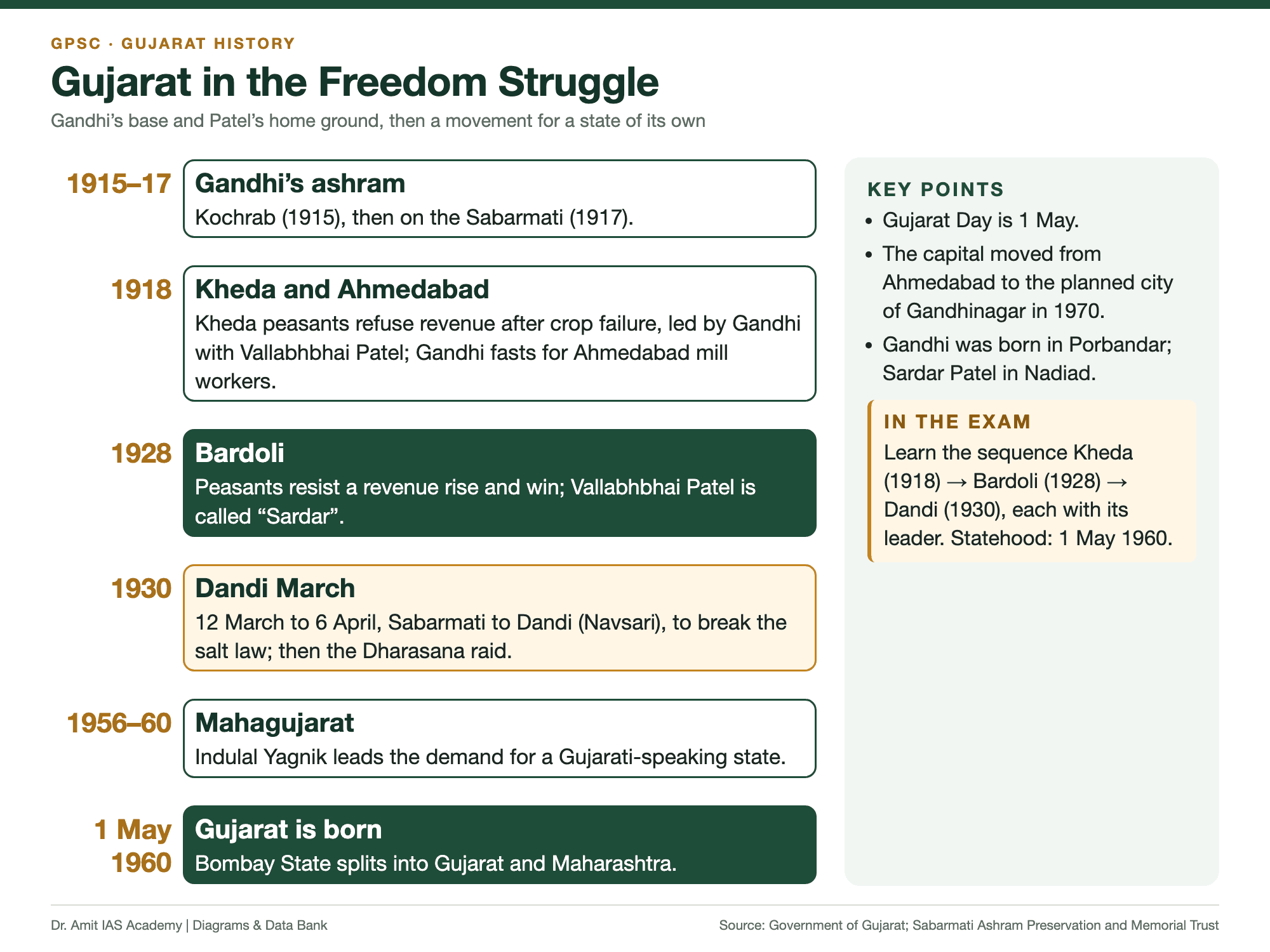
The diagram is a vertical timeline of Gujarat from Gandhi's return to India to the birth of the state. Its subtitle frames the story: Gujarat was Gandhi's base and Patel's home ground, and after independence it fought for a state of its own. Six dated boxes run down the left. The first, for 1915 to 1917, marks Gandhi's ashram, first at Kochrab and then on the Sabarmati. The 1918 box covers the Kheda peasants and the Ahmedabad mill workers. The 1928 box, shaded dark, is Bardoli. The 1930 box, picked out in amber, is the Dandi March. The last two boxes cover the Mahagujarat movement of 1956 to 1960 and the creation of Gujarat on 1 May 1960. A side panel lists key points, and an exam note asks the reader to learn the sequence Kheda, Bardoli, Dandi, each with its leader.
Gandhi and Patel in Gujarat
After returning from South Africa, Gandhi set up his ashram at Kochrab in Ahmedabad in 1915 and moved it to the banks of the Sabarmati in 1917. From this base Gujarat became a testing ground for satyagraha.
- Kheda, 1918: after crop failure, peasants of Kheda district refused to pay land revenue. Gandhi led the campaign with Vallabhbhai Patel, then a lawyer in Ahmedabad.
- Ahmedabad, 1918: in a dispute between mill owners and workers over wages, Gandhi went on a fast, his first in India, to keep the workers firm, and the dispute was settled.
- Bardoli, 1928: peasants resisted a steep rise in land revenue under Patel's organisation and won. The women of Bardoli gave him the title "Sardar".
The Dandi March
On 12 March 1930 Gandhi set out from the Sabarmati Ashram with a small band of volunteers and walked to Dandi, on the coast in today's Navsari district, reaching it on 6 April. By picking up salt there he broke the salt law and launched the Civil Disobedience Movement across India. After his arrest the campaign turned to the Dharasana salt works, where the beating of peaceful satyagrahis by the police drew attention around the world.
Mahagujarat and statehood
The States Reorganisation of 1956 kept Gujarati and Marathi speakers together in a large bilingual Bombay State. In Gujarat this set off the Mahagujarat movement, led by Indulal Yagnik, demanding a separate Gujarati-speaking state. A parallel Samyukta Maharashtra movement made the same demand on the Marathi side. On 1 May 1960 Bombay State was split into Gujarat and Maharashtra, which is why 1 May is Gujarat Day. Ahmedabad served as the first capital until the government moved to the planned city of Gandhinagar in 1970.
Why it matters for the exam
For GPSC Class 1 and 2, this topic sits in the history and culture of Gujarat and in the Indian national movement, in the Preliminary general studies paper and in the Mains general studies paper on history and culture. Questions ask for the year of a movement, its leader, the order of events, or the birthplaces of leaders such as Gandhi at Porbandar and Patel at Nadiad. Mains questions ask for Gujarat's role in the national movement or the background to the state's formation.
Quick revision
- Gandhi's ashram: Kochrab in 1915, then Sabarmati in 1917.
- Kheda Satyagraha and the Ahmedabad mill strike: both in 1918.
- Bardoli Satyagraha, 1928: Vallabhbhai Patel becomes "Sardar".
- Dandi March: 12 March to 6 April 1930, then the Dharasana raid.
- Mahagujarat movement, 1956 to 1960, led by Indulal Yagnik.
- Gujarat formed on 1 May 1960; capital moved to Gandhinagar in 1970.