The Freedom Struggle in Rajasthan
1857, the peasant and tribal movements and the praja mandals.
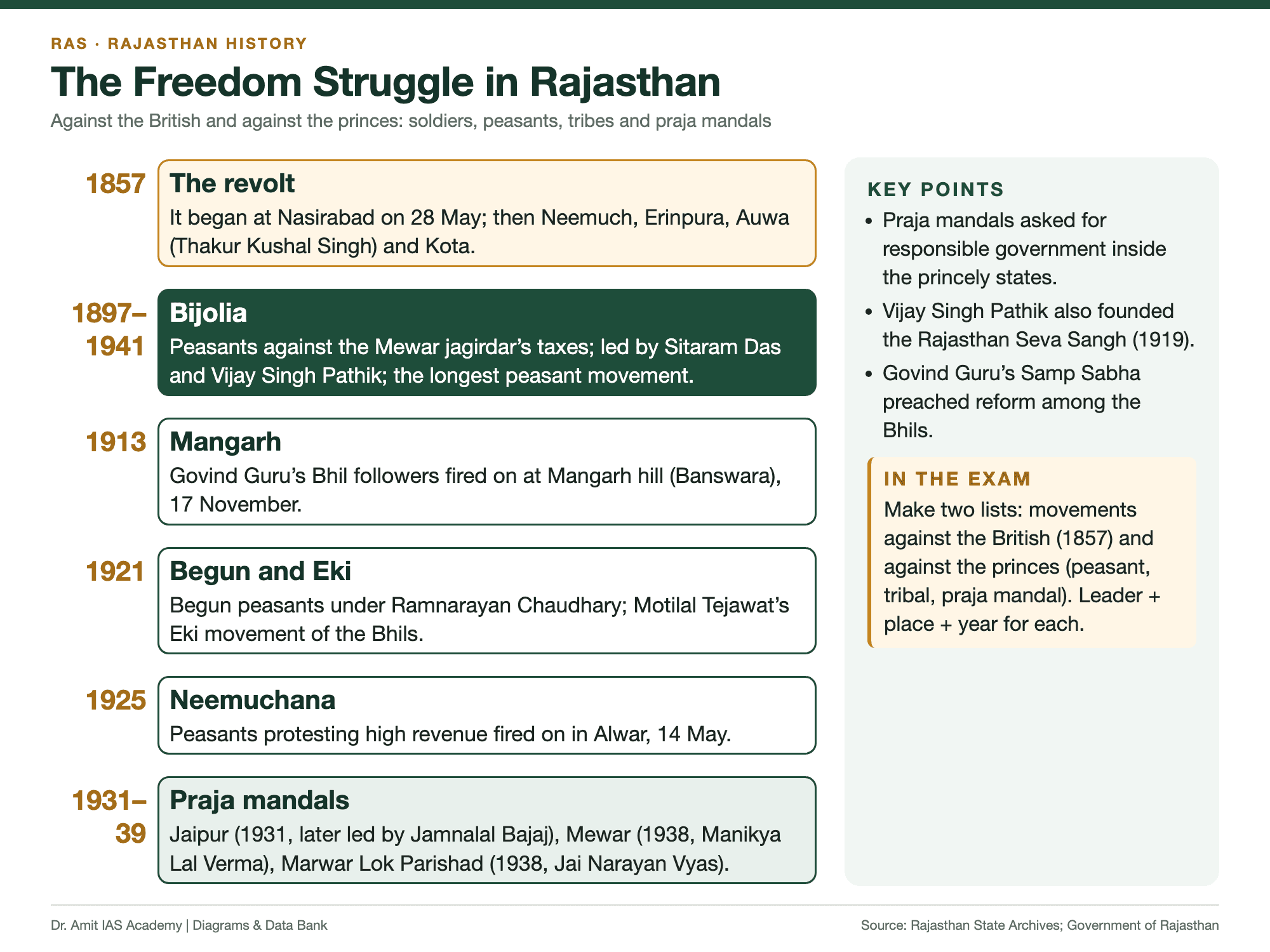
What the diagram shows
The diagram is a timeline running down the left side, with a year on the left of each box. It opens with the revolt of 1857 and then moves through the long Bijolia peasant movement (1897 to 1941), the Mangarh firing of 1913, the Begun and Eki movements of 1921, the Neemuchana firing of 1925 and finally the praja mandals of 1931 to 1939. Its subtitle sums up the theme: the struggle was fought against the British and also against the princes. A side panel lists key points, and a box headed "In the exam" suggests sorting the movements into two lists and learning the leader, place and year of each.
1857: the revolt against the British
Rajputana was largely ruled by princes allied with the British, so 1857 here was mainly a revolt of soldiers in the cantonments and of some discontented thakurs.
- It began at Nasirabad on 28 May 1857, when the sepoys there rose.
- It spread to Neemuch and to Erinpura, where soldiers of the Jodhpur Legion rebelled.
- At Auwa, Thakur Kushal Singh joined the rebels and resisted the forces of Jodhpur and the British.
- At Kota, troops of the state rose against the ruler and the British political agent.
Peasant and tribal movements against the princes
After 1857 the main grievance of ordinary people was heavy land revenue, cesses and forced labour imposed by rulers and jagirdars.
- Bijolia, a thikana of Mewar: peasants protested against the jagirdar's many taxes. Its leaders included Sadhu Sitaram Das and later Vijay Singh Pathik, it is regarded as the longest peasant movement in the region.
- Mangarh (Banswara), 17 November 1913: Bhils gathered under Govind Guru were fired upon on Mangarh hill. Govind Guru's Samp Sabha had preached social reform among the Bhils.
- Begun, 1921: a peasant movement under Ramnarayan Chaudhary.
- Eki, 1921: a Bhil movement led by Motilal Tejawat against excessive demands on the tribals.
- Neemuchana (Alwar), 14 May 1925: peasants protesting high revenue were fired upon.
The praja mandals
From the 1930s the struggle took a political form. The praja mandals demanded responsible government inside the princely states and civil liberties for the people.
- Jaipur Praja Mandal (1931), later led by Jamnalal Bajaj.
- Mewar Praja Mandal (1938), founded by Manikya Lal Verma.
- Marwar Lok Parishad (1938), led by Jai Narayan Vyas.
Vijay Singh Pathik also founded the Rajasthan Seva Sangh in 1919, which helped link the peasant movements with wider political work.
Why it matters for the exam
This topic belongs to the history of Rajasthan in RAS Prelims and in Mains General Studies Paper I. Questions usually ask you to match a movement with its leader, place or year, to identify where an event such as the Mangarh firing took place, or to explain in a short answer how peasant and tribal movements prepared the ground for the praja mandals. Longer answers may ask for the role of 1857 in Rajputana or the demand for responsible government in the princely states.
Quick revision
- 1857 began at Nasirabad on 28 May; Auwa's Thakur Kushal Singh resisted.
- Bijolia (1897 to 1941): Sitaram Das and Vijay Singh Pathik; the longest peasant movement.
- Mangarh, Banswara, 17 November 1913: Govind Guru's Bhil followers fired upon.
- 1921: Begun under Ramnarayan Chaudhary; Eki under Motilal Tejawat.
- Neemuchana, Alwar, 14 May 1925: peasants fired upon over high revenue.
- Praja mandals sought responsible government: Jaipur 1931, Mewar 1938, Marwar Lok Parishad 1938.