How Haryana Was Formed, 1966
From part of Punjab to India’s 17th state on 1 November 1966.
What the diagram shows
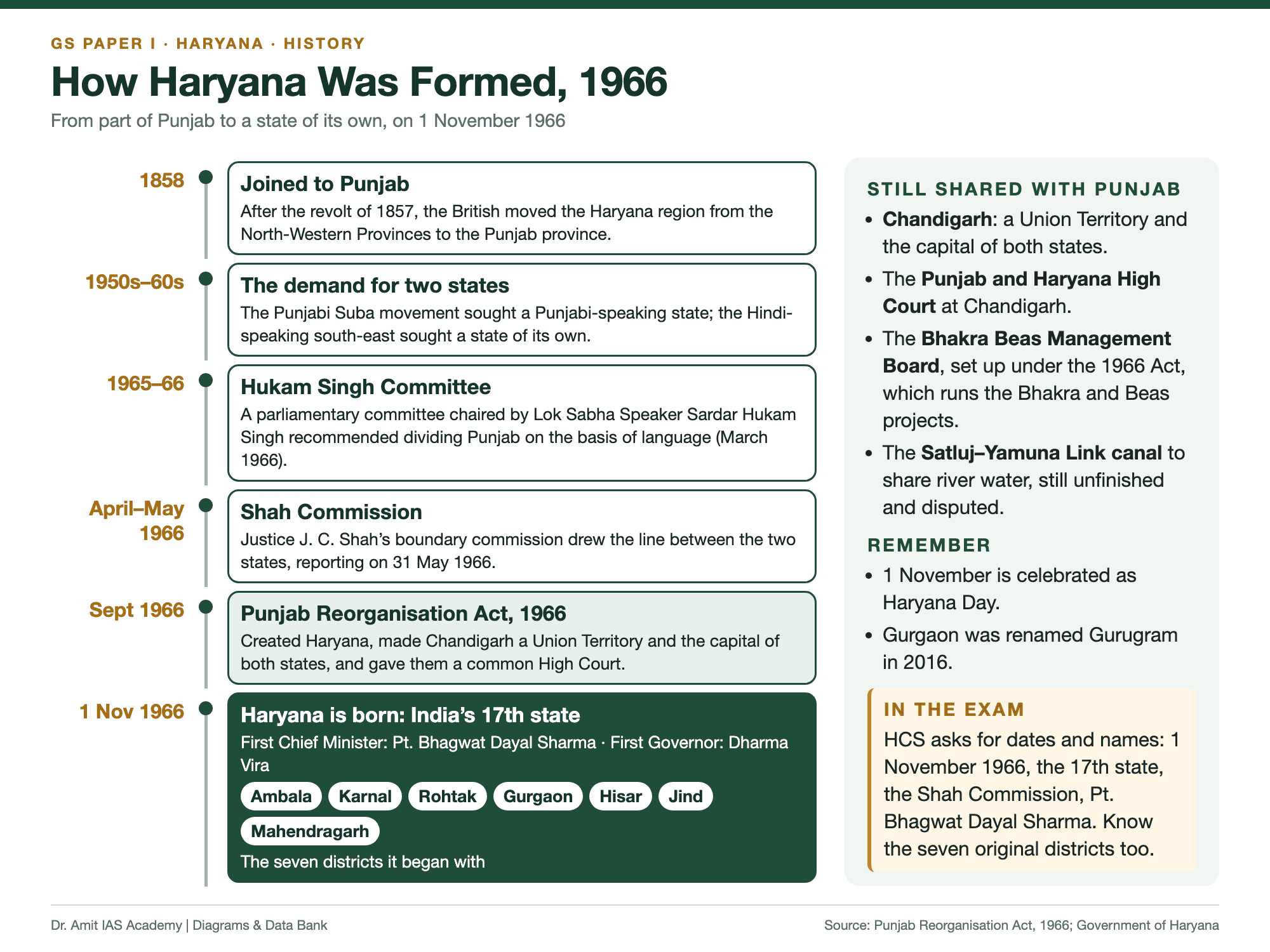
The diagram is a vertical timeline in six steps, read from top to bottom, that traces how the Hindi-speaking south-east of Punjab became a state of its own. It opens in 1858, when the region was joined to Punjab, moves through the 1950s–60s demand for two states, the Hukam Singh Committee (1965–66) and the Shah Commission (April–May 1966), and reaches the Punjab Reorganisation Act, 1966 (September 1966). The last box, shaded dark green, marks 1 November 1966: Haryana is born as India's 17th state, with its first Chief Minister, its first Governor and the seven districts it began with. A side panel lists what Haryana still shares with Punjab, points to remember and an exam note.
From a Punjab region to a separate state
- 1858: after the revolt of 1857, the British took the Haryana region away from the North-Western Provinces and attached it to the Punjab province.
- The demand for two states: in the 1950s and 1960s the Punjabi Suba movement pressed for a Punjabi-speaking state, while leaders of the Hindi-speaking south-east asked for a separate state of their own.
- Hukam Singh Committee: a parliamentary committee chaired by the Lok Sabha Speaker, Sardar Hukam Singh, recommended in March 1966 that Punjab be reorganised on a linguistic basis.
- Shah Commission: a boundary commission headed by Justice J. C. Shah was set up to draw the actual line between the Punjabi-speaking and Hindi-speaking areas. It submitted its report on 31 May 1966.
The Punjab Reorganisation Act, 1966
Parliament acted through the Punjab Reorganisation Act, 1966, passed in September 1966. The Act did three things the diagram highlights: it created Haryana, it made Chandigarh a Union Territory serving as the capital of both Punjab and Haryana, and it gave the two states a common High Court, the Punjab and Haryana High Court at Chandigarh.
The new state came into being on 1 November 1966. Pt. Bhagwat Dayal Sharma became its first Chief Minister and Dharma Vira its first Governor. Haryana began with seven districts: Ambala, Karnal, Rohtak, Gurgaon, Hisar, Jind and Mahendragarh. Gurgaon has since been renamed Gurugram (2016).
What Haryana still shares with Punjab
Beyond the capital and the High Court, the two states share the Bhakra Beas Management Board, which traces back to the 1966 Act and runs the Bhakra and Beas projects, and the Satluj–Yamuna Link canal, meant to share river water but still unfinished and disputed.
Why it matters for the exam
For HCS, the formation of Haryana sits in the Haryana history portion of General Studies, in both Prelims and Mains. Prelims questions test dates and names: the date of formation, the number of the state, the first Chief Minister and Governor, the Shah Commission and the original districts. Mains questions ask why the state was formed, how the linguistic principle was applied, and why issues such as the shared capital and the Satluj–Yamuna Link canal remain unresolved. For UPSC, the same story belongs to GS Paper I under the reorganisation of states after Independence.
Quick revision
- Haryana region joined to Punjab province in 1858, after the revolt of 1857.
- Hukam Singh Committee (March 1966) backed a linguistic division of Punjab.
- Shah Commission drew the boundary and reported on 31 May 1966.
- Punjab Reorganisation Act, 1966: Haryana created, Chandigarh a shared Union Territory capital, common High Court.
- Haryana became India's 17th state on 1 November 1966, now celebrated as Haryana Day.
- First CM Pt. Bhagwat Dayal Sharma, first Governor Dharma Vira, seven original districts.