Folk Dances and Folk Deities of Rajasthan
Dances and their communities, the Panch Pir and the phad.
What the diagram shows
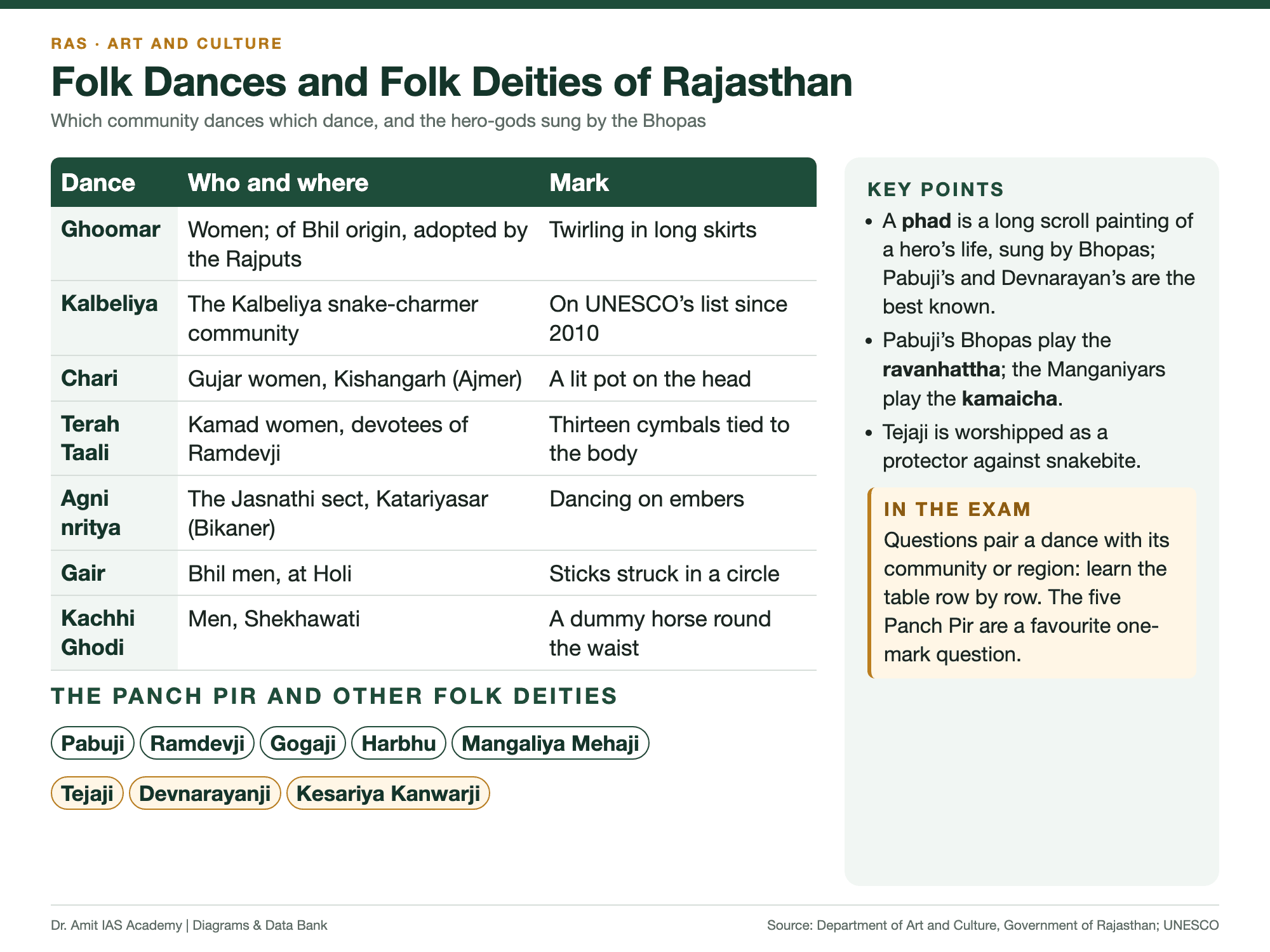
The diagram is built around a table of seven folk dances of Rajasthan, set out in three columns: the name of the dance, who performs it and where, and the one mark that identifies it. Below the table, a row of five green-outlined tags names the Panch Pir, and a second row of three orange tags adds other folk deities: Tejaji, Devnarayanji and Kesariya Kanwarji. A side panel of key points explains the phad, the instruments of the Bhopas and the Manganiyars, and why Tejaji is worshipped.
Folk dances and their communities
Most dances of Rajasthan belong to a particular community, sect or region, and that link is the fact to learn. The table pairs them as follows:
- Ghoomar: danced by women, of Bhil origin and later adopted by the Rajputs; known for twirling in long, flared skirts.
- Kalbeliya: the dance of the Kalbeliya snake-charmer community; inscribed on UNESCO's list of the Intangible Cultural Heritage of Humanity in 2010.
- Chari: performed by Gujar women of the Kishangarh area of Ajmer, balancing on the head a pot with a flame burning in it.
- Terah Taali: performed by women of the Kamad community, devotees of Ramdevji, with thirteen small cymbals (manjiras) tied to the body.
- Agni nritya: the fire dance of the Jasnathi sect, centred on Katariyasar in Bikaner, in which dancers move on burning embers.
- Gair: danced by Bhil men at Holi, striking sticks as they move in a circle.
- Kachhi Ghodi: a men's dance of the Shekhawati region, with a dummy horse fixed round the dancer's waist.
The Panch Pir and other folk deities
Rajasthan's folk deities (lok devta) are mostly local heroes who protected cattle, the weak or their word, and came to be worshipped after death. Five of them are grouped together as the Panch Pir: Pabuji, Ramdevji, Gogaji, Harbhu and Mangaliya Mehaji.
The diagram adds three more deities outside this group. Tejaji is worshipped as a protector against snakebite. Devnarayanji is a hero-god held in special reverence by the Gujar community. Kesariya Kanwarji completes the list.
Phad, Bhopas and folk music
A phad is a long scroll painting of a hero's life. The Bhopas, priest-singers of these deities, unroll it at night and sing the story panel by panel. The phads of Pabuji and Devnarayan are the best known. Pabuji's Bhopas accompany the recital on the ravanhattha, a bowed string instrument, while the Manganiyars, hereditary musicians of western Rajasthan, play the kamaicha.
Why it matters for the exam
Art and culture of Rajasthan is a fixed part of the RAS syllabus: folk dances, folk deities, folk music and instruments, and painting traditions such as the phad come up in both the Preliminary and the Main examination. Prelims questions usually ask the candidate to match a dance with its community or region, pick the odd one out from a list of deities, or identify which names belong to the Panch Pir. Mains asks short notes on a dance, a deity or the phad tradition.
Quick revision
- Kalbeliya: snake-charmer community; on UNESCO's list since 2010.
- Chari: Gujar women of Kishangarh with a lit pot; Terah Taali: Kamad women with thirteen cymbals.
- Agni nritya: Jasnathi sect, Katariyasar (Bikaner), dancing on embers.
- Panch Pir: Pabuji, Ramdevji, Gogaji, Harbhu, Mangaliya Mehaji.
- Tejaji: protector against snakebite; Devnarayanji: revered by the Gujars.
- Phad of Pabuji is sung by Bhopas on the ravanhattha; Manganiyars play the kamaicha.