Dances, Crafts and Fairs of Gujarat
Garba and folk dances, Patola and Rogan, and the big fairs.
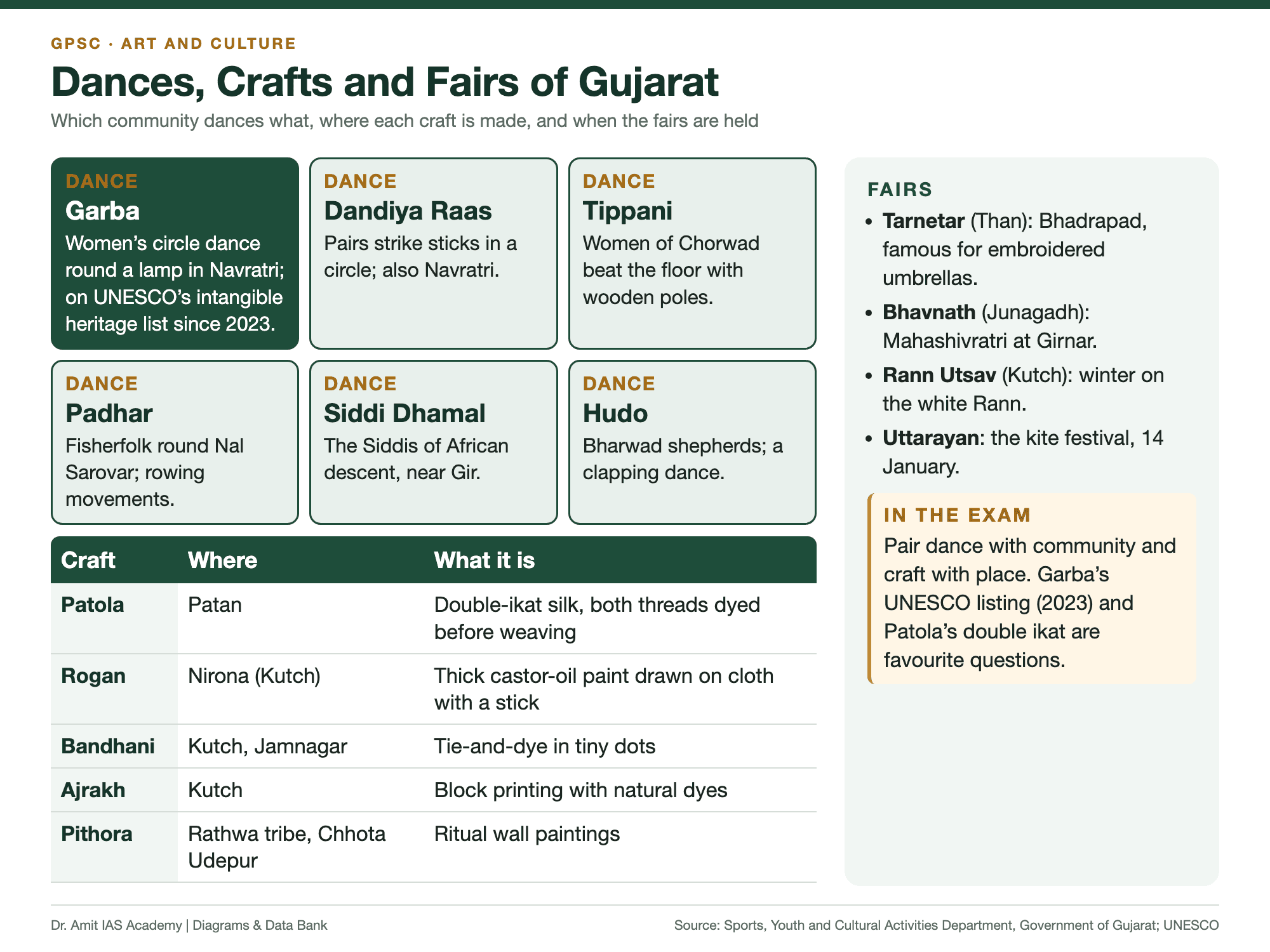
What the diagram shows
The diagram is laid out in three blocks. The top left holds six cards, one for each dance, each naming the community that performs it or the occasion on which it is danced. Garba sits in the first card, shaded dark green to set it apart from the other five. Below the cards, a table pairs five crafts with the place where each is made and a one-line description of the technique. On the right, a panel lists four fairs and festivals with their place and season, and a short note sums up what examiners like to ask.
Folk dances and their communities
- Garba: a circle dance by women round a lamp during Navratri. It was inscribed on UNESCO's Representative List of the Intangible Cultural Heritage of Humanity in 2023.
- Dandiya Raas: dancers in pairs strike sticks (dandiyas) as they move in a circle, also danced in Navratri.
- Tippani: women of Chorwad on the Saurashtra coast beat the floor with wooden poles, a dance that grew out of the work of ramming floors.
- Padhar: the fisherfolk living round the Nal Sarovar wetland, whose movements copy rowing.
- Siddi Dhamal: danced by the Siddis, a community of African descent settled near Gir.
- Hudo: a clapping dance of the Bharwad shepherds.
The pattern to remember is that most folk dances of Gujarat belong to a particular community, and the community's work or origin explains the movements.
Crafts and where they are made
- Patola of Patan: silk woven in double ikat, in which both the warp and the weft threads are tie-dyed before weaving, so the design appears identically on both sides.
- Rogan of Nirona in Kutch: a thick paste made from castor oil is drawn on cloth with a stick rather than applied with a brush.
- Bandhani of Kutch and Jamnagar: tie-and-dye in which the cloth is pinched and tied into tiny dots.
- Ajrakh of Kutch: block printing with natural dyes, usually in deep blue and red.
- Pithora: ritual wall paintings made by the Rathwa tribe of Chhota Udepur.
Fairs and festivals
The Tarnetar fair near Than is held in the month of Bhadrapad and is known for its embroidered umbrellas. The Bhavnath fair in Junagadh gathers sadhus at the foot of Girnar at Mahashivratri. The Rann Utsav in Kutch is a winter festival on the white salt desert of the Rann. Uttarayan, the kite festival, falls on 14 January.
Why it matters for the exam
The cultural heritage of Gujarat is a regular part of the GPSC Class 1 and 2 syllabus, in the general studies paper of the preliminary examination and in the Mains general studies paper that covers history and cultural heritage. Questions are usually of the matching kind: dance with community, craft with place, fair with district or season. Statement questions test the technique behind a craft, such as what makes Patola a double ikat, and recent recognition such as Garba's UNESCO listing. In the Mains, a short note on a craft or fair can draw on these same facts.
Quick revision
- Garba: women's Navratri circle dance, on UNESCO's intangible heritage list since 2023.
- Tippani of Chorwad, Padhar of Nal Sarovar, Siddi Dhamal near Gir, Hudo of the Bharwads.
- Patola of Patan is double ikat: both sets of threads dyed before weaving.
- Rogan of Nirona uses castor-oil paint; Ajrakh and Bandhani belong to Kutch.
- Pithora wall paintings belong to the Rathwa tribe of Chhota Udepur.
- Tarnetar in Bhadrapad, Bhavnath at Mahashivratri, Rann Utsav in winter, Uttarayan on 14 January.