Crafts and Folk Culture of Uttar Pradesh
ODOP crafts by city, folk songs and dances, UNESCO listings.
What the diagram shows
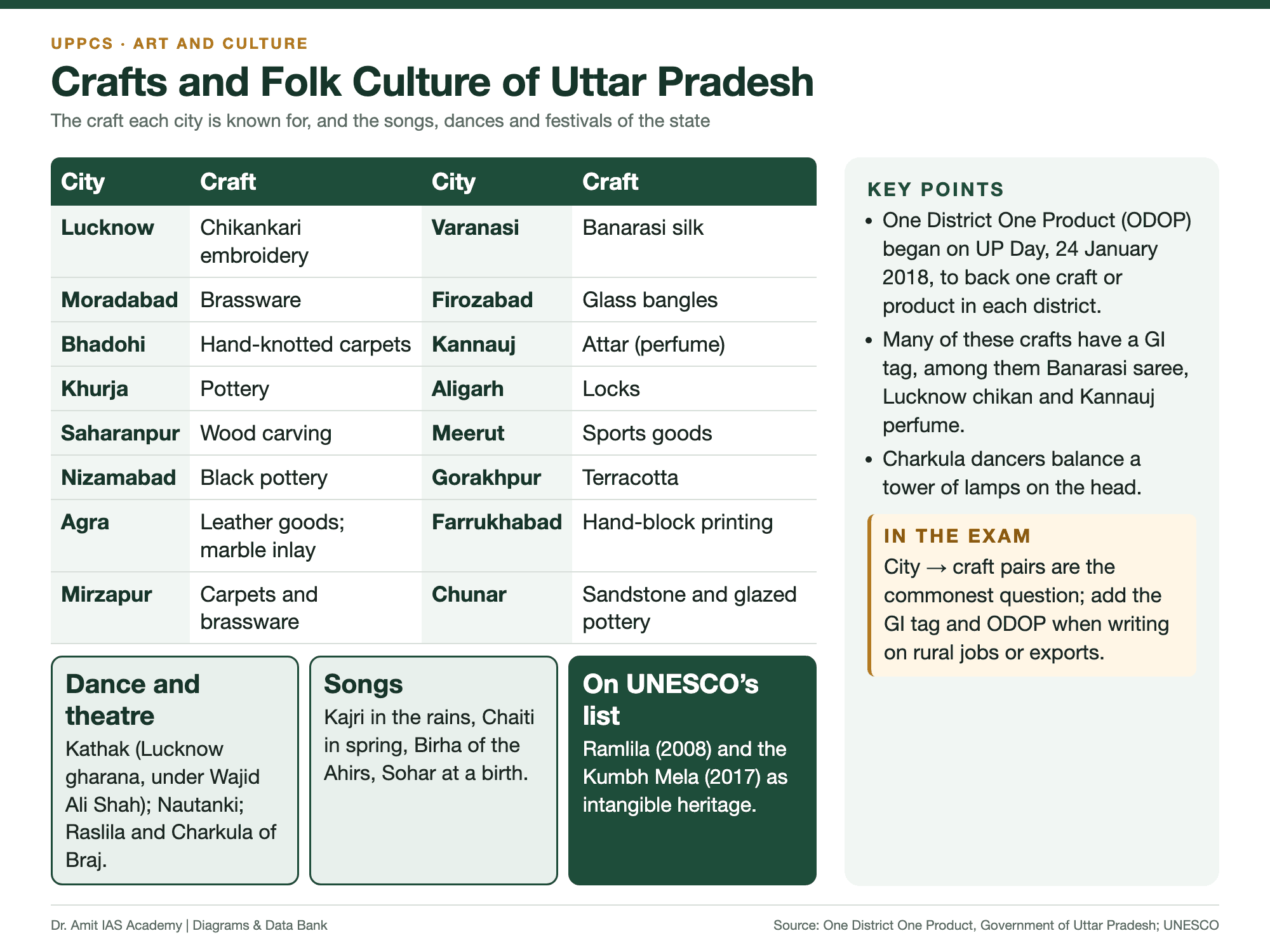
The diagram is built around a two-sided table that pairs sixteen cities of Uttar Pradesh with the craft each is known for, from Lucknow's chikankari to Chunar's sandstone and glazed pottery. Below the table, three boxes cover the state's folk culture: dance and theatre, folk songs, and the traditions linked to the state that are on UNESCO's list of intangible cultural heritage. A side panel of key points explains the One District One Product (ODOP) scheme, the Geographical Indication (GI) tags held by several of these crafts and the Charkula dance, with a note on how the topic is tested.
Cities and their crafts
Most crafts of the state are tied to a single town. The table pairs them as follows:
- Textiles and embroidery: Lucknow (chikankari embroidery), Varanasi (Banarasi silk), Bhadohi (hand-knotted carpets), Mirzapur (carpets and brassware) and Farrukhabad (hand-block printing).
- Metal and glass: Moradabad (brassware), Aligarh (locks) and Firozabad (glass bangles).
- Clay and stone: Khurja (pottery), Nizamabad near Azamgarh (black pottery), Gorakhpur (terracotta) and Chunar (sandstone and glazed pottery).
- Other crafts: Saharanpur (wood carving), Kannauj (attar, or perfume), Meerut (sports goods) and Agra (leather goods and marble inlay).
The ODOP scheme, launched by the state government on UP Day, 24 January 2018, picks one craft or product in each district and supports it with credit, training, design help and marketing. Many of the crafts also carry a GI tag, which ties a product to its place of origin; the diagram names the Banarasi saree, Lucknow chikan and Kannauj perfume as examples.
Folk dance, theatre and songs
- Kathak: the classical dance of the region; its Lucknow gharana grew under the patronage of Nawab Wajid Ali Shah.
- Nautanki: a popular form of folk theatre mixing song, dialogue and drama.
- Raslila: dance-drama of the Braj region on the life of Krishna.
- Charkula: a dance of Braj in which performers balance a tall tower of lit lamps on the head.
Folk songs follow the seasons and the events of life. Kajri is sung in the rains, Chaiti in spring, Birha is associated with the Ahir community, and Sohar is sung at the birth of a child.
UNESCO intangible heritage
Two traditions closely linked to the state are on UNESCO's Representative List of the Intangible Cultural Heritage of Humanity: Ramlila, the staged performance of the Ramayana, inscribed in 2008, and the Kumbh Mela, inscribed in 2017. Both are wider than Uttar Pradesh alone: Ramlila is staged across north India, and the Kumbh rotates among four sites, of which Prayagraj is the one in the state.
Why it matters for the exam
For UPPCS, this topic sits in the art and culture part of General Studies Paper I and in the Uttar Pradesh-specific general knowledge asked in the Prelims and in the state papers of the Mains. Prelims questions most often ask the candidate to match cities with crafts, or folk songs and dances with their region or occasion. Mains answers on rural employment, MSMEs, exports or tourism gain from citing ODOP and GI tags with examples.
Quick revision
- Lucknow: chikankari; Varanasi: Banarasi silk; Firozabad: glass bangles; Moradabad: brassware.
- Bhadohi and Mirzapur: carpets; Kannauj: attar; Aligarh: locks; Meerut: sports goods.
- Nizamabad: black pottery; Khurja: pottery; Gorakhpur: terracotta; Saharanpur: wood carving.
- ODOP began on UP Day, 24 January 2018: one product for each district.
- Kajri (rains), Chaiti (spring), Birha (Ahirs), Sohar (birth); Charkula and Raslila of Braj.
- On UNESCO's list: Ramlila (2008) and Kumbh Mela (2017).