Buddhist and Jain Councils
Where, when, under whom, and what each council decided.
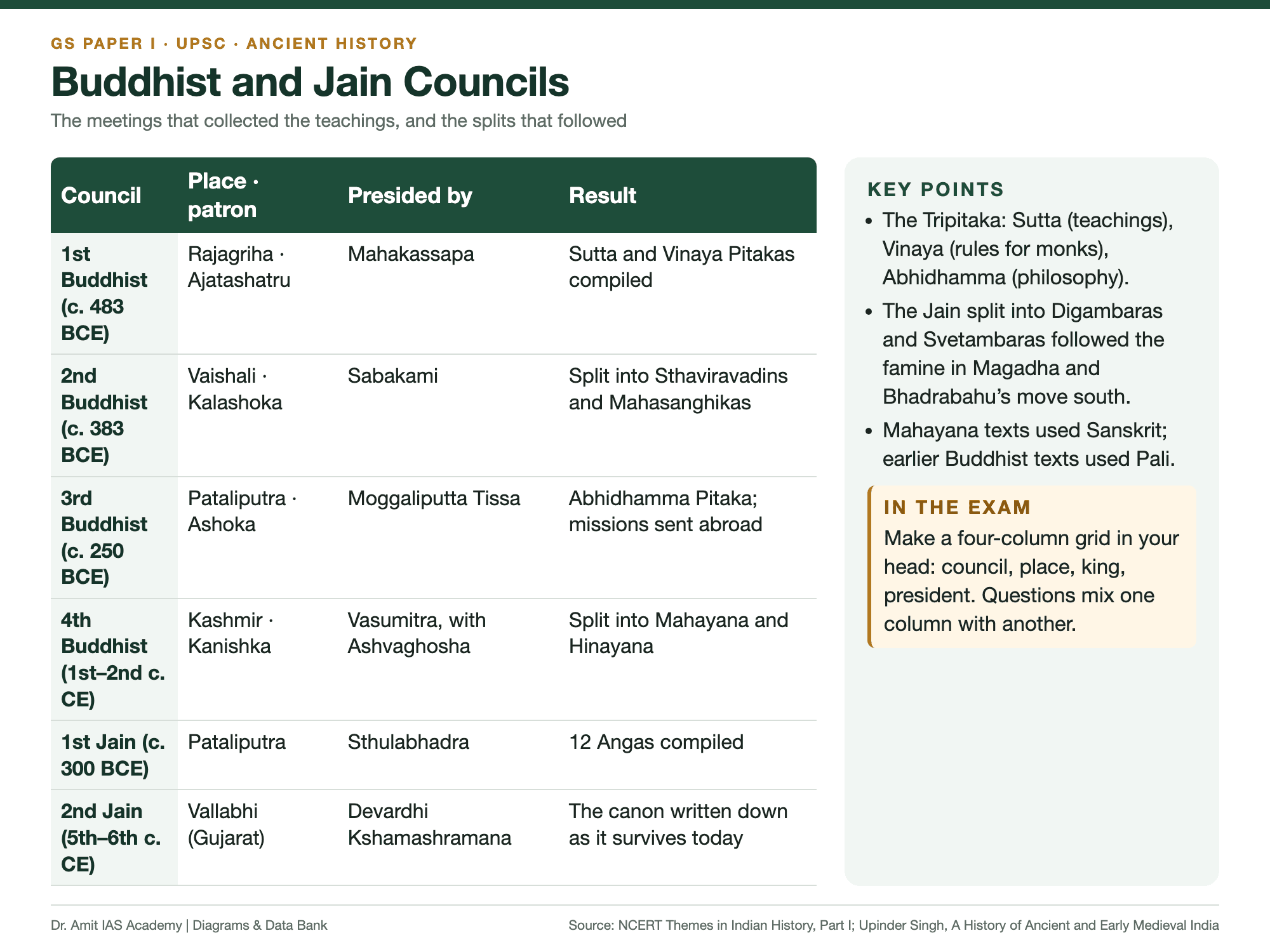
What the diagram shows
The diagram is a single table with four columns: the council and its approximate date, the place and patron king, the monk who presided, and the result. The first four rows are the Buddhist councils, in order from the 5th century BCE to the 1st or 2nd century CE. The last two rows are the Jain councils at Pataliputra and Vallabhi. A side panel lists key points on the three Pitakas, the Jain split and the languages of the texts, and an exam note suggests remembering a grid of council, place, king and president, because questions mix one column with another.
The four Buddhist councils
- First (c. 483 BCE): held at Rajagriha soon after the Buddha's death, under the patronage of Ajatashatru of Magadha and presided over by Mahakassapa. The Buddha's teachings were collected as the Sutta Pitaka and the monastic rules as the Vinaya Pitaka.
- Second (c. 383 BCE): held at Vaishali under King Kalashoka, presided over by Sabakami. Disputes over monastic discipline led to the split of the Sangha into the Sthaviravadins (elders) and the Mahasanghikas.
- Third (c. 250 BCE): held at Pataliputra under Ashoka and presided over by Moggaliputta Tissa. The Abhidhamma Pitaka was added and missionaries were sent to spread the Dhamma in India and abroad.
- Fourth (1st to 2nd century CE): held in Kashmir under the Kushana king Kanishka, presided over by Vasumitra with Ashvaghosha. It is linked with the division of Buddhism into Mahayana and Hinayana.
The Tripitaka, languages and the Jain councils
Together the three baskets form the Tripitaka: the Sutta Pitaka (the teachings), the Vinaya Pitaka (rules for monks and nuns) and the Abhidhamma Pitaka (philosophy). The early canon was preserved in Pali, while Mahayana texts came to be written in Sanskrit.
Jainism held two councils of its own:
- First (c. 300 BCE): at Pataliputra, presided over by Sthulabhadra, where the twelve Angas were compiled.
- Second (5th to 6th century CE): at Vallabhi in Gujarat, presided over by Devardhi Kshamashramana, where the Svetambara canon was finally written down in the form that survives today.
The division of Jainism into Digambaras and Svetambaras is traced to a long famine in Magadha, when Bhadrabahu led a group of monks to the south while others stayed behind with Sthulabhadra. The two groups later differed on practice, notably on whether monks should wear clothes.
Why it matters for the exam
The councils belong to Ancient Indian History in UPSC General Studies Paper I and in the history sections of the HCS, RAS, UPPCS and GPSC preliminary papers, under religious movements of the 6th century BCE and the Mauryan and Kushana periods. Prelims questions usually test matching: a council with its venue, a king with the council he supported, or a president with his council. Statement-based questions also ask which Pitaka was compiled when, where the Jain canon was written down, or which council saw a particular split. In the Mains, the councils support answers on the spread of Buddhism and on royal patronage of religion.
Quick revision
- Buddhist councils in order: Rajagriha, Vaishali, Pataliputra, Kashmir.
- Patrons in order: Ajatashatru, Kalashoka, Ashoka, Kanishka.
- Presidents in order: Mahakassapa, Sabakami, Moggaliputta Tissa, Vasumitra.
- First council: Sutta and Vinaya; third council: Abhidhamma; fourth council: Mahayana and Hinayana.
- Jain councils: Pataliputra under Sthulabhadra (12 Angas) and Vallabhi under Devardhi Kshamashramana (Svetambara canon written down).
- Digambara and Svetambara split followed the Magadha famine and Bhadrabahu's move south.