Ancient Uttar Pradesh: Mahajanapadas and Buddhist Sites
The mahajanapadas in UP and the places of the Buddha’s life.
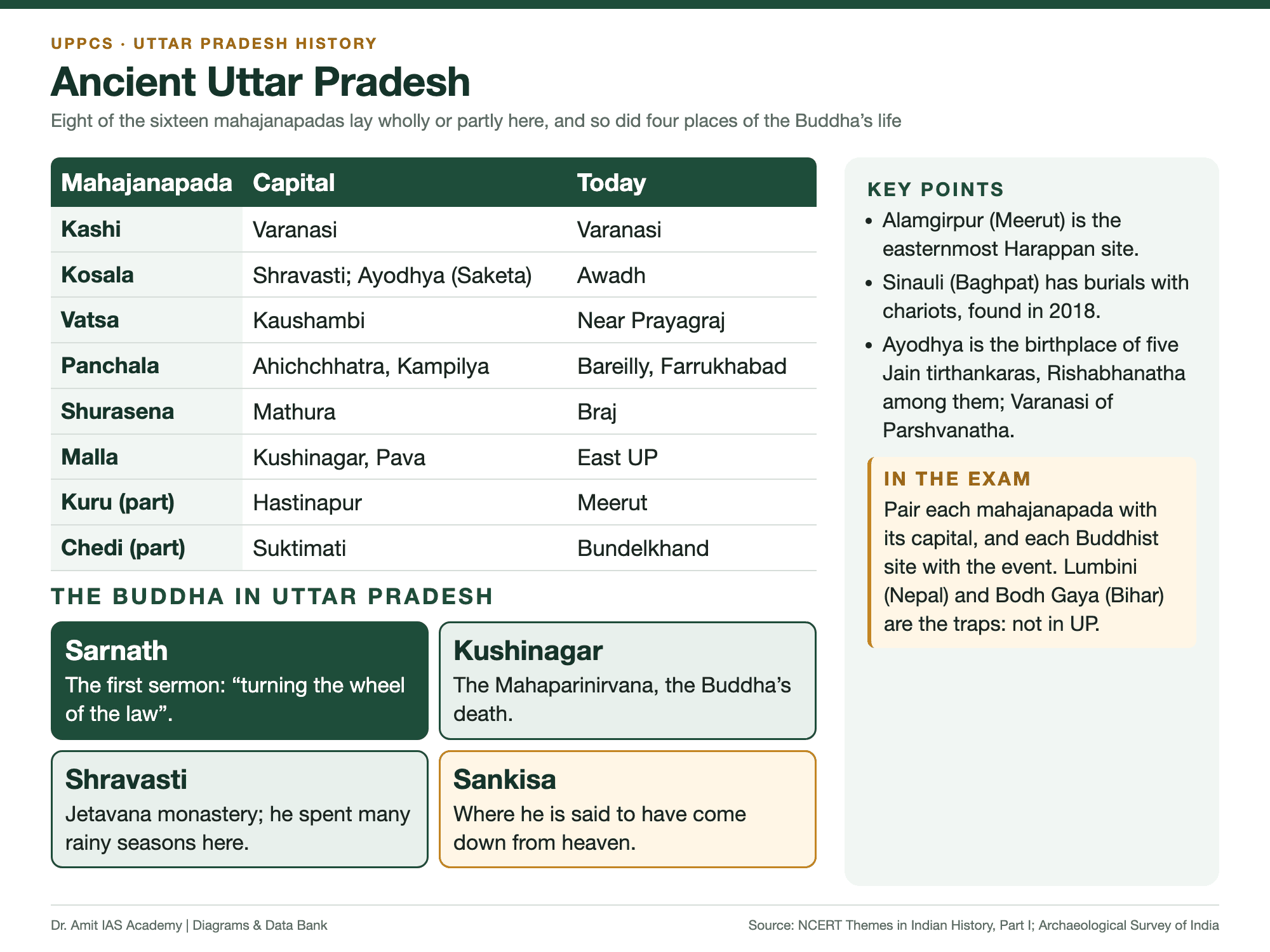
What the diagram shows
The chart opens with one line that sums up the topic: eight of the sixteen mahajanapadas lay wholly or partly in today's Uttar Pradesh, and so did four places of the Buddha's life. The main table has three columns: the mahajanapada, its capital and the area it covers today. Below it, four boxes headed “The Buddha in Uttar Pradesh” name Sarnath, Kushinagar, Shravasti and Sankisa with the event linked to each. A side panel lists key points on Harappan and Jain sites, and an “In the exam” note warns about the two places that are often wrongly placed in UP.
The mahajanapadas of Uttar Pradesh
By the sixth century BCE, northern India was divided among large states that Buddhist and Jain texts list as the sixteen mahajanapadas. Half of them touched what is now Uttar Pradesh:
- Kashi, with its capital at Varanasi.
- Kosala, with Shravasti and Ayodhya (Saketa), covering roughly the Awadh region.
- Vatsa, with its capital at Kaushambi near Prayagraj.
- Panchala, with Ahichchhatra (Bareilly area) and Kampilya (Farrukhabad area).
- Shurasena, with its capital at Mathura in the Braj region.
- Malla, a republic (gana-sangha) in eastern UP, with centres at Kushinagar and Pava.
- Kuru, partly in UP, linked with Hastinapur in Meerut district.
- Chedi, partly in UP, with Suktimati as its capital and the Bundelkhand region as its area.
Kashi and Kosala fought over territory, and both were later absorbed into the growing power of Magadha, which lay outside UP in present-day Bihar.
The Buddha in Uttar Pradesh
Four of the places tied to the Buddha's life are in the state:
- Sarnath, near Varanasi: the first sermon, known as “turning the wheel of the law” (Dhammachakkappavattana).
- Kushinagar: the Mahaparinirvana, the Buddha's death, in the land of the Mallas.
- Shravasti: the Jetavana monastery, where he spent many rainy seasons.
- Sankisa: where he is said to have come down from heaven.
Lumbini, his birthplace, is in Nepal, and Bodh Gaya, where he attained enlightenment, is in Bihar. Neither is in Uttar Pradesh.
Older and other traditions
The side panel adds three facts. Alamgirpur in Meerut district is the easternmost Harappan site. Sinauli in Baghpat district has burials with chariots, found in 2018. In Jain tradition, Ayodhya is the birthplace of five tirthankaras, Rishabhanatha among them, and Varanasi is the birthplace of Parshvanatha.
Why it matters for the exam
In UPPCS, this topic belongs to General Studies Paper I (history) and to the Uttar Pradesh-specific history that the state's syllabus covers. Prelims questions usually ask the reader to match a mahajanapada with its capital, pair a Buddhist site with its event, or pick which of a list of places lies in UP. Mains questions can ask about the political map of the Ganga plain before the Mauryas or about the state's Buddhist heritage and its tourism value.
Quick revision
- Eight of the sixteen mahajanapadas lay wholly or partly in UP.
- Kosala: Shravasti and Ayodhya; Vatsa: Kaushambi; Shurasena: Mathura.
- Panchala had two centres, Ahichchhatra and Kampilya; Malla had Kushinagar and Pava.
- Sarnath for the first sermon, Kushinagar for the Mahaparinirvana.
- Shravasti for Jetavana, Sankisa for the descent from heaven.
- Lumbini (Nepal) and Bodh Gaya (Bihar) are not in UP.