Ancient Haryana: Vedas to Harsha
Brahmavarta, Kurukshetra, the Yaudheyas and Harsha of Thanesar.
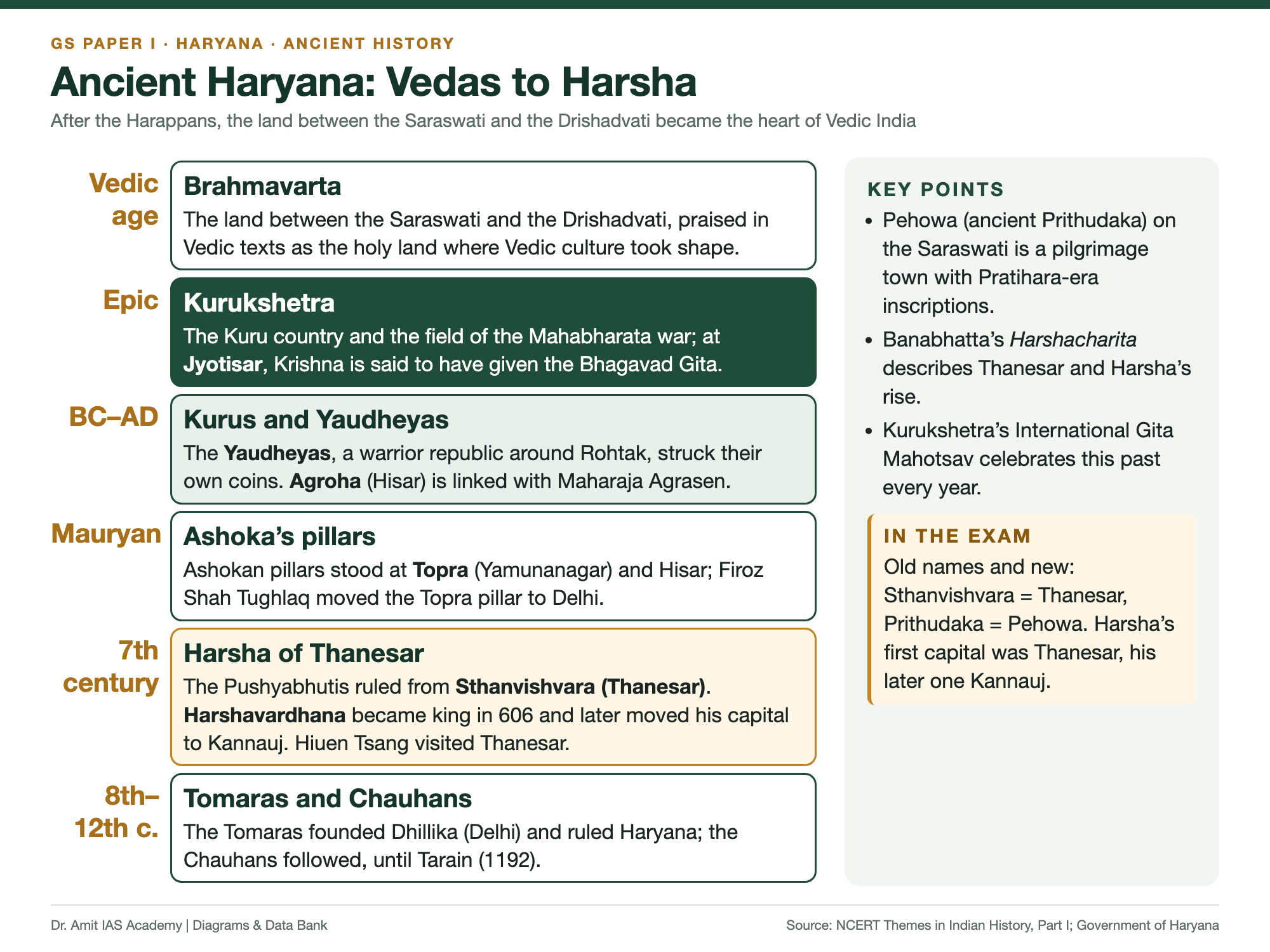
What the diagram shows
The diagram is a vertical timeline of Haryana's ancient past, from the Vedic age to the end of the twelfth century. Its subtitle sets the scene: after the Harappans, the land between the Saraswati and the Drishadvati became the heart of Vedic India. Down the left margin run the period labels: Vedic age, Epic, BC–AD, Mauryan, 7th century and 8th–12th century. Each label is paired with a box: Brahmavarta, Kurukshetra (highlighted in dark green), Kurus and Yaudheyas, Ashoka's pillars, Harsha of Thanesar (highlighted in amber) and Tomaras and Chauhans. A side panel lists key points on Pehowa, the Harshacharita and the International Gita Mahotsav, and an “In the exam” note pairs old place names with new ones.
From Brahmavarta to the republics
Ancient texts, notably the Manusmriti, describe Brahmavarta, the tract between the Saraswati and the Drishadvati, as a holy land created by the gods, and it is seen as a core area of later Vedic culture. This region later formed part of the Kuru country, and Kurukshetra is remembered as the battlefield of the Mahabharata. Tradition places the sermon of the Bhagavad Gita at Jyotisar, near Kurukshetra.
In the centuries around the turn of the era, the Yaudheyas stand out. They were a warrior republic (a gana-sangha rather than a monarchy) centred around Rohtak, and they issued their own coins, which tell us much of what we know about them. Agroha in Hisar district is linked by tradition with Maharaja Agrasen.
Ashoka, Harsha and after
- Mauryan period: Ashokan pillars are linked with Topra (Yamunanagar) and Hisar. In the fourteenth century Firoz Shah Tughlaq had the Topra pillar carried to Delhi, where it still stands.
- Pushyabhutis: this dynasty ruled from Sthanvishvara (Thanesar). Harshavardhana became king in 606 AD and later shifted his capital to Kannauj. The Chinese pilgrim Hiuen Tsang (Xuanzang) visited Thanesar, and Banabhatta's Harshacharita describes the city and Harsha's rise.
- Pehowa: ancient Prithudaka, on the Saraswati, is a pilgrimage town whose inscriptions date from the Pratihara era.
- Tomaras and Chauhans: tradition credits the Tomaras with founding Dhillika (Delhi), and they ruled over much of Haryana; the Chauhans followed them, until their defeat at Tarain in 1192 opened north India to the Ghurids.
This past is still celebrated: Kurukshetra hosts the International Gita Mahotsav every year.
Why it matters for the exam
For HCS, this topic belongs to the history of Haryana within General Studies, in both Prelims and Mains. Questions tend to test matching of ancient and modern place names (Sthanvishvara with Thanesar, Prithudaka with Pehowa), the location of sites such as Topra, Agroha and Jyotisar, the nature of the Yaudheya republic and its coinage, and the sources for Harsha's reign. For UPSC, Harsha, the Pushyabhutis, Hiuen Tsang, Ashokan pillars and the Battle of Tarain are part of the national ancient and early medieval history syllabus, so the same facts serve both papers.
Quick revision
- Brahmavarta: the land between the Saraswati and the Drishadvati, praised as holy in ancient texts.
- Jyotisar near Kurukshetra is where the Gita is said to have been given.
- Yaudheyas: a warrior republic around Rohtak that struck its own coins.
- Topra pillar of Ashoka was moved to Delhi by Firoz Shah Tughlaq.
- Harsha became king at Thanesar in 606 AD and later ruled from Kannauj.
- Sthanvishvara = Thanesar; Prithudaka = Pehowa.