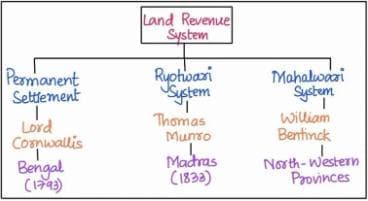
Q19. How far did various land-revenue settlements lead to the growth of commercialization of agriculture during colonial rule and its impact on rural society?
Show AnswerHide Answer
Model Answer
“Land revenue reforms reshaped agrarian relations in colonial India.”Historian perspective
Colonial land-revenue settlements (Permanent Settlement, Ryotwari, Mahal/Zaamindari) restructured agrarian property relations and were pivotal in commercialising agriculture with profound social and economic consequences.
Revenue Settlements and Commercialization
Permanent Settlement (1793, Bengal): Fixed revenue and recognized zamindars as proprietors. Led zamindars to extract higher rents and encouraged cash crop cultivation (indigo, jute) for market returns, fostering commercialization but often creating peasant indebtedness.
Ryotwari (Madras, Bombay): Direct peasant settlement with revenue fixed per individual cultivator. Encouraged peasants to respond to market signals; however, high assessments and frequent revisions pushed peasants toward cash crops to meet cash demands.
Mahal/Mirzai (Punjab and North-West Provinces): Village headman or community liable; collective responsibility encouraged growth of marketable grains and cash crops where markets existed.
Mechanisms Promoting Commercialization
Cash Revenue Demands: Forced peasants and zamindars to grow cash crops or sell produce to meet monetary obligations.
Infrastructure and Market Integration: Railways and ports (colonial investments) connected interiors to global markets, making cash cultivation profitable.
Commercial Crops and Plantation Economy: Indigo, cotton, opium, tea, and jute became major export crops.
Impact on Rural Society
Peasant Indebtedness and Land Alienation: High revenue demands and crop failures led peasants into moneylender debt; frequent land sales to moneylenders or zamindars increased landlessness.
Social Differentiation: New rural elites (landlord class, moneylenders) emerged; traditional communal village bonds weakened.
Change in Cropping Patterns: Food crop acreage reduced in many regions; risk of famines increased (e.g., Bengal Famine 1770 and later 1943 had complex causes including commercialization).
Labour Migration & Distress: Seasonal migration to plantations and urban centres increased.
Agricultural Productivity: In some areas commercialization brought investments and cash income, but benefits were uneven and often captured by elites.
Example
Under British Punjab administration, canal colonization (late 19th–early 20th C) in regions now part of Haryana (Canal colonies) led to commercialization wheat and cash grain expansion. This fostered agrarian prosperity for allottee settlers but also introduced class stratification and consolidation of land holdings.
Colonial land-revenue settlements undoubtedly accelerated commercialization by monetizing agrarian relations and integrating Indian agriculture into global markets. However, the process was often exploitative, fostering indebtedness, land alienation, and rural inequality. The legacy shaped post-Independence agrarian reforms aimed at land ceilings, tenancy reforms, and poverty alleviation.
Hand-drawn chart of British land revenue systems: Permanent Settlement (Cornwallis, Bengal 1793), Ryotwari (Thomas Munro, Madras) and Mahalwari (William Bentinck, North-Western Provinces)