Question
Highlight the major changes brought about by National Education Policy, 2020 in the education system of India.
Show AnswerHide Answer
Model Answer
The National Education Policy (NEP), 2020, approved after 34 years since the last policy (1986), represents a paradigm shift in India’s education system. It aims to transform India into a “knowledge society” by aligning education with 21st-century skills, inclusivity, and innovation. Anchored in the vision of “Equitable, Inclusive, Holistic, and Multidisciplinary Education,” it covers school to higher education through structural, pedagogical, and governance reforms.
Major Changes Brought by NEP 2020
1. Structural Reform in School Education
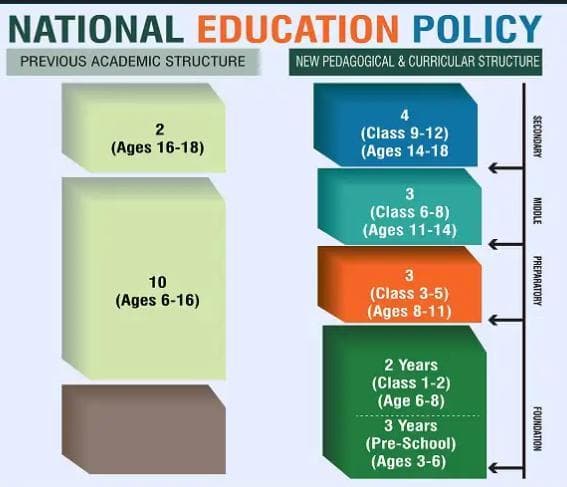
- New Structure: Replaces the old 10+2 system with a 5+3+3+4 model corresponding to Foundational (3–8 yrs), Preparatory (8–11 yrs), Middle (11–14 yrs), and Secondary (14–18 yrs) stages.
- Early Childhood Care & Education (ECCE): Integrated into formal schooling, recognizing Anganwadis and pre-schools as part of foundational learning.
- Focus on Learning Outcomes: Target of achieving foundational literacy and numeracy (FLN) by 2026–27 through the NIPUN Bharat Mission.
Case Study:
Haryana’s Saksham Haryana Programme (adopted under NEP framework) improved Grade 3 learning outcomes from 42% (2016) to 79% (2023) a model replicated by NITI Aayog under the Aspirational Districts Programme.
2. Multilingual and Holistic Education
- Mother Tongue as Medium: Instruction up to Grade 5 (preferably till Grade 8) in the home language or regional language to strengthen conceptual learning.
- Multidisciplinary Curriculum: Emphasis on arts, sports, and vocational education as integral parts of curriculum, not extras.
- Bagless Days introduced for skill-based learning.
Example: Bilingual education initiatives in Haryana and Gujarat align with NEP’s multilingual goals, making education inclusive for rural learners.
3. Reform in Higher Education
- Holistic and Multidisciplinary Approach: Single-stream institutions to be replaced with Multidisciplinary Education and Research Universities (MERUs).
- Multiple Entry–Exit System (MEES): Students can earn certificates, diplomas, or degrees at different stages.
- Academic Bank of Credits (ABC): Enables digital storage and transfer of academic credits across institutions.
- Target: Increase Gross Enrolment Ratio (GER) in higher education from 27% (2019) to 50% by 2035.
4. Vocationalization and Skill Development
- At least 50% of learners to have exposure to vocational education by 2025.
- Integration with Skill India and National Skills Qualification Framework (NSQF) for employability.
Example: Haryana Skill Development Mission (HSDM) partnered with industry clusters in Gurugram to implement NEP-aligned vocational modules in government schools.
5. Digital and Technological Integration
- National Educational Technology Forum (NETF) and DIKSHA Platform for teacher training, e-content, and online learning.
- PM e-VIDYA initiative (2020) ensures multi-mode access digital, TV (SWAYAM PRABHA), and radio learning.
6. Governance and Institutional Reforms
- Higher Education Commission of India (HECI): To replace UGC, AICTE, and NCTE with 4 verticals Regulation, Accreditation, Funding, and Standards.
- School Complex System: Promotes resource sharing among small schools.
- National Research Foundation (NRF): Allocated ₹50,000 crore (2023–28) to boost R&D and innovation.
7. Equity and Inclusion
- Special emphasis on gender inclusion, SC/ST/OBC, and rural students through targeted scholarships and Gender Inclusion Fund (GIF).
- Adult Education and Open Schooling restructured for lifelong learning.
Example: Haryana’s Beti Padhao–Digital Shiksha model integrates NEP objectives of girls’ digital inclusion through mobile-based literacy drives.
NITI Aayog India @100 (2023): Estimated NEP could raise India’s education-linked productivity by 1.5% of GDP annually by 2030.
The National Education Policy 2020 marks a historic reform shifting focus from rote learning to critical thinking, flexibility, and inclusiveness.
As India advances toward Viksit Bharat@2047, the true success of NEP 2020 will depend on coordinated implementation, state-level innovation, and adequate investment in human capital ensuring that education truly becomes the foundation of equitable national growth.