
The Seven Principles of Public Life
The Nolan principles, and how to use them in answers.
What the diagram shows
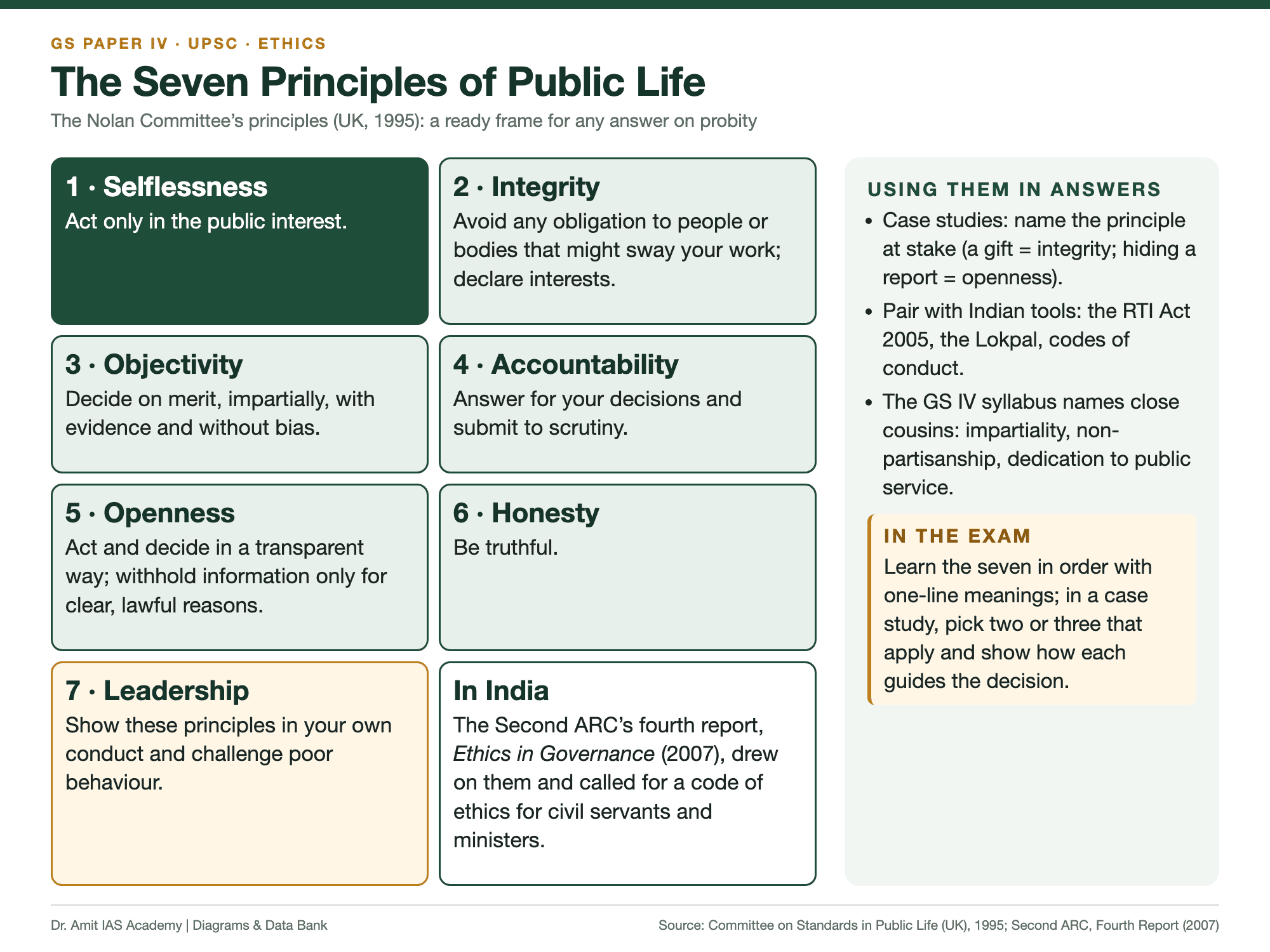
The diagram sets out the seven principles of public life framed by the Nolan Committee in the United Kingdom in 1995. They appear as seven numbered boxes, each with a one-line meaning: Selflessness (act only in the public interest), Integrity (avoid any obligation to people or bodies that might sway your work, and declare interests), Objectivity (decide on merit, impartially, with evidence and without bias), Accountability (answer for your decisions and submit to scrutiny), Openness (act and decide transparently, withholding information only for clear, lawful reasons), Honesty (be truthful) and Leadership (show these principles in your own conduct and challenge poor behaviour). An eighth box, "In India", links them to the Second Administrative Reforms Commission. A side panel explains how to use the principles in answers, and a highlighted note gives a short exam tip.
Where the principles come from
The Committee on Standards in Public Life was set up in the UK in the mid-1990s, after a series of controversies over the conduct of members of Parliament, and was first chaired by Lord Nolan. Its first report, in 1995, stated these seven principles as the standard expected of everyone who holds public office, from ministers and civil servants to members of public bodies. They remain the reference point for codes of conduct in British public life.
The principles are best read as a set. Selflessness and integrity deal with motive and conflicts of interest; objectivity and honesty deal with how decisions are reached; accountability and openness deal with answerability to the public; leadership asks officials to model all of them and to speak up when others fall short.
The Indian connection
As the diagram notes, the Second Administrative Reforms Commission drew on the Nolan principles in its fourth report, Ethics in Governance (2007). It recommended a code of ethics for civil servants and for ministers, alongside measures to fight corruption. When writing about Indian administration, the principles can be paired with Indian tools that put them into practice:
- Openness: the Right to Information Act, 2005.
- Accountability and integrity: the Lokpal and Lokayuktas, and conduct rules for government servants.
- Objectivity and impartiality: values such as impartiality, non-partisanship and dedication to public service, which the GS Paper IV syllabus itself names as foundational values for the civil service.
Why it matters for the exam
The principles belong to UPSC General Studies Paper IV (Ethics, Integrity and Aptitude), under probity in governance, codes of ethics and codes of conduct, and foundational values for civil service. State PCS mains papers that include an ethics or administrative ethics section cover similar ground. Questions may ask you to explain a principle such as objectivity or accountability, to compare a code of ethics with a code of conduct, or to discuss the Second ARC's recommendations. In case studies, the principles give a quick frame: name the principle at stake (accepting a gift is a test of integrity; hiding a report is a failure of openness), pick two or three that apply, and show how each guides the decision.
Quick revision
- Seven principles: Selflessness, Integrity, Objectivity, Accountability, Openness, Honesty, Leadership.
- Source: the Committee on Standards in Public Life (Nolan Committee), UK, first report 1995.
- Integrity means avoiding obligations that could sway your work and declaring interests.
- Openness allows withholding information only for clear, lawful reasons.
- Second ARC's fourth report, Ethics in Governance (2007), drew on them for codes of ethics.
- Pair them with the RTI Act 2005, the Lokpal and codes of conduct in Indian answers.