Question
What is Aaditya L-1? Underline the significance of this mission in the field of space science and technology.
Show AnswerHide Answer
Model Answer
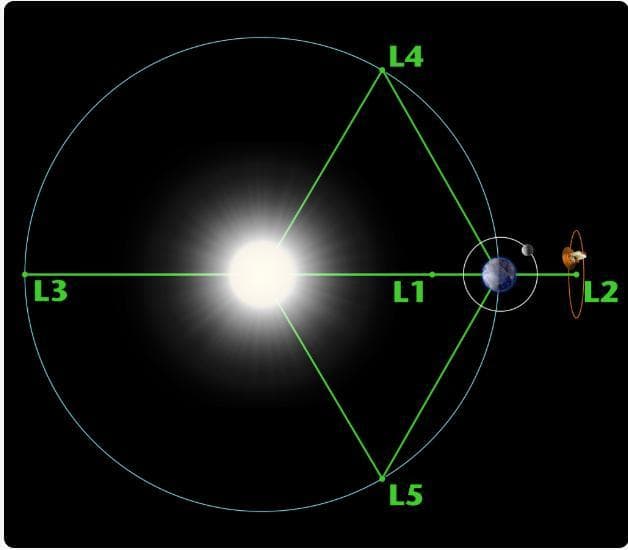
Aditya-L1 is India’s first dedicated solar mission, launched by the Indian Space Research Organisation (ISRO) on September 2, 2023. The spacecraft is positioned at the Lagrange Point 1 (L1) about 1.5 million km from Earth where the gravitational forces of Earth and the Sun balance each other, allowing continuous observation of the Sun without orbital obstruction.
About the Mission
- Mission Type: Solar Observation
- Launch Vehicle: PSLV-C57
- Orbit: Halo orbit around L1 point
- Agencies Involved: ISRO in collaboration with various Indian research institutions like IUCAA, IISER Pune, and PRL Ahmedabad.
- Payloads (7 Instruments):
- VELC (Visible Emission Line Coronagraph) Studies solar corona and coronal mass ejections.
- SUIT (Solar Ultraviolet Imaging Telescope) Observes the photosphere and chromosphere.
- ASPEX and PAPA: Analyze solar wind and energetic particles.
- SoLEXS and HEL1OS: Observe X-ray emissions.
- MAG (Magnetometer): Measures interplanetary magnetic fields.
Significance of Aditya-L1 Mission
1. Scientific Significance
- Understanding Solar Activity: Provides crucial data on solar flares, coronal mass ejections (CMEs), and space weather phenomena affecting satellite communication and power grids on Earth.
- Advance in Heliophysics: Helps in mapping the magnetic field dynamics of the Sun’s corona, a longstanding mystery in solar physics.
- Continuous Monitoring: L1 orbit enables uninterrupted solar observation, unlike Earth-based telescopes obstructed by night cycles and atmospheric distortion.
2. Technological Significance
- Mastery over Lagrangian Point Navigation: India joins an elite group of nations (USA, ESA, Japan) capable of placing observatories at L1- a feat requiring precise orbital mechanics and deep-space communication.
- Enhanced Space Weather Forecasting: Data aids in predicting geomagnetic storms that can disrupt power systems, navigation, and defense communication.
- Boost to Indigenous Instrumentation: All payloads were indigenously designed and developed, strengthening India’s capability in space-based optics and plasma instrumentation.
3. Strategic and Societal Relevance
- Supports safe operation of satellites under the Indian Regional Navigation Satellite System (IRNSS) and communication networks like GSAT.
- Advances India’s preparedness for future interplanetary missions such as Gaganyaan and Shukrayaan by improving understanding of solar radiation hazards.
- Establishes India as a contributor to global solar research, enhancing scientific diplomacy through data-sharing with NASA’s Parker Solar Probe and ESA’s Solar Orbiter.
Haryana Connection (National Contribution Example)
Institutions like IISER Mohali (adjacent to Haryana) and Kurukshetra University’s Physics Department collaborate in solar physics research, integrating data from Aditya-L1 for studying plasma waves and solar wind showing how Indian academia contributes across states to national space endeavors.
The Aditya-L1 mission marks a transformative milestone in India’s space journey from observing distant planets to now studying our own star with indigenous precision. It not only deepens our understanding of the Sun’s influence on Earth and space weather but also symbolizes India’s growing autonomy and confidence in advanced space science and technology; a true leap from “Made in India” to “Discovering with India.”