Which of the following statements are true?
1. GDPMP is the market value of all final Goods and Services produced within the geographical boundary of a country in a year.
2. If the GDP of a country is rising, the welfare may not rise as a consequence.
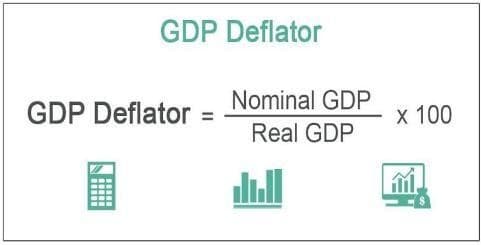
3. The ratio of nominal GDP to Real GDP is called GDP Deflator.
4. The ratio of real GDP to nominal GDP is called GDP Deflator.
Options
A1, 2 and 3 only
B2, 3 and 4 only
C1, 3 and 4 only
D1, 2 and 4 only
Show AnswerHide Answer
Correct Answer
A1, 2 and 3 only
Model Answer
Gross domestic product (GDP) at market price is a key economic indicator that measures the total value of all goods and services produced in a country during a specific period. Hence, statement 1 is correct. It's calculated by adding the cost of production to indirect taxes: Market Price (MP) = Cost of Production or factor cost + Net Indirect Taxes
If a nation's GDP increases, well-being may not increase as a result. That's because the increase in GDP may be disproportionately consolidated in the hands of a small group of people or enterprises. Hence, statement 2 is correct.
When comparing nominal GDP to real GDP, we can see how prices have changed between the base year the year whose prices are used to compute real GDP and the present year.
The volume of production is fixed while determining the real and nominal GDP for the current year.
As the price level between the base year and the current year changed, any discrepancy between these metrics is solely attributable to that shift.
One well-known measure of prices is the nominal GDP to real GDP ratio. This is known as the GDP Deflator. Hence, statement 3 is correct.
Hence, GDP deflator = GDP/gdp, if GDP represents nominal GDP and gdp, represents real GDP.
Hence, statement 4 is incorrect.
Graphic titled GDP Deflator showing the formula GDP Deflator = Nominal GDP / Real GDP x 100.