Consider the following statements about Yeast:
1. Yeast are fungi.
2. Yeast can form pseudomycelium
3. Yeast reproduce asexually by budding.
4. Yeasts are facultative anaerobes.
5. All Yeasts are dimorphic.
6. All Yeasts are pathogenic.
Which of the above are correct?
Options
A1,2,3,4
B1,2,3,6
C3,4,5,6
D2,3,4,5
Show AnswerHide Answer
Correct Answer
A1,2,3,4
Model Answer
About Yeast
Yeasts are single-celled, eukaryotic microorganisms that belong to the fungi kingdom. Hence statement 1 is correct.
There are at least 1,500 species of yeast that are currently recognized and are thought to make up 1% of all fungal species that have been described.
Some species of yeast are capable of developing multicellular characteristics by forming strings of connected budding cells known as pseudohyphae or false hyphae also known as pseudomycelium. Hence, statement 2 is correct.
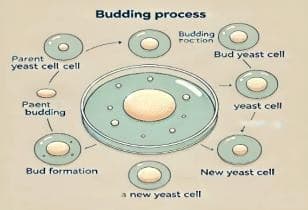
The majority of yeasts reproduce asexually through mitosis, and many of them do so through budding, an asymmetric division process. Hence statement 3 is correct.
Budding
The asexual process of creating new organisms is known as budding. A new organism is created from a small portion of the parent's body during this process. When a bud forms, it separates to become a new organism.
Hydra uses regenerative cells for reproduction, in which a bud grows as an outgrowth from repeated cell division at a single location. After that, these buds developed into new, tiny individuals that, once fully matured, separate from the parent body.
Respiration
Yeasts are indeed facultative anaerobes. This means that they can survive and grow in both the presence and absence of oxygen. Hence statement 4 is correct.
In the absence of oxygen, yeasts switch to anaerobic respiration, specifically fermentation. This process is less efficient in terms of ATP production compared to aerobic respiration.
In fermentation, glucose is converted into ethanol and carbon dioxide, which is the basis of alcohol production and bread making.
Dimphorism
Fungal species that can take both forms (depending on temperature or other conditions) are called dimorphic fungi.
Dimorphic is thus often used as a general reference for fungi being able to switch between yeast and filamentous cells, but not necessary limiting more shapes.
Hence statement 5 is incorrect.
Pathogenic Yeast
Not all yeasts are pathogenic.
Generally, most yeast species are opportunistic human pathogens and given the right immunocompromised circumstances, all species have the ability to kill a human host.
Hence statement 6 is incorrect.
A diagram titled Budding process showing a yeast cell forming a bud that separates into a new yeast cell.