Question
Q3. Bring out the differences between Moderates and Extremists in India's National Movement.
Show AnswerHide Answer
Model Answer
“No great movement springs fully grown. It evolves.”
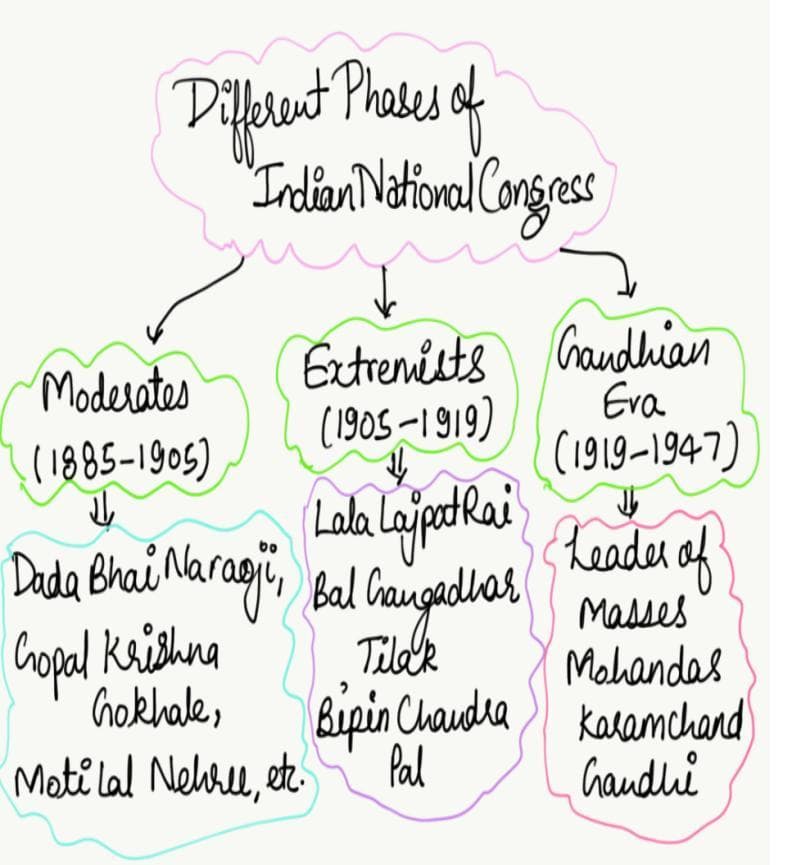
The Indian National Movement before independence evolved through two distinct ideological phases the Moderate phase (1885–1905) and the Extremist phase (1905–1919). While Moderates laid the intellectual foundation of nationalism, Extremists infused the movement with mass sentiment, assertiveness and the call for complete Swaraj. Together, they transformed India’s political awakening into a powerful national struggle.
Ideological Foundation
- Moderates: Influenced by Western liberalism and faith in constitutional reforms. Leaders like Dadabhai Naoroji, G.K. Gokhale, D.E. Wacha believed British rule could be reformed.
- Extremists: Inspired by ancient Indian traditions, cultural pride and nationalism. Leaders like Bal Gangadhar Tilak, Lala Lajpat Rai, B.C. Pal criticized the British as exploiters.
Objectives and Conception of Swaraj
- Moderates: Demanded self-government similar to dominions (e.g., Canada, Australia).
- Extremists: Declared Swaraj as complete independence (Poorna Swaraj), anticipating the 1929 Lahore Resolution.
Attitude Towards British Rule
- Moderates: Believed British rule initially had positive roles railways, legal systems, modern education.
- Extremists: Saw British rule as economic imperialism; cited Drain of Wealth Theory (Naoroji estimated India lost 200–300 million rupees annually).
Methods of Struggle
Moderates:Petitions, resolutions, speeches, meetings
- Negotiation and dialogue through British Parliament
- Strategy known as “Prayer and Petition”
Extremists:
- Swadeshi, Boycott, National Education
- Passive resistance and people's mobilization
- Emotional appeal rooted in self-respect and sacrifice
Nature of Leadership and Support Base
- Moderates: Leadership mainly educated middle-class and urban elites.
- Extremists: Mobilized peasants, youth, workers, small traders, making nationalism a mass movement.
Historical Contributions
Moderates:
- Built political consciousness, organizational structure of INC.
- Exposed colonial exploitation through works like Economic Drain Theory, Poverty and Un-British Rule.
Extremists:
- Brought emotional intensity, self-confidence and unity.
- Prepared ground for Gandhian mass movements (Non-Cooperation, Civil Disobedience).
Special Reference to Haryana
- Lala Lajpat Rai (“Punjab Kesari”), a key Extremist leader, strongly influenced the Haryana region (then part of Punjab).
- He promoted national education and Swadeshi in Hisar, Rewari, and Rohtak.
- The Arya Samaj movement, highly influential in Haryana, became a major mobilizing force for Extremist ideology encouraging:
- Swadeshi schools (Gurukuls)
- Anti-caste reform
- National consciousness
- His death (1928) after the Simon Commission protest lathi-charge in Lahore sparked a nationwide wave of martyr-inspired nationalism, echoed strongly in Haryana’s political resistance.
The Moderates and Extremists were not opposing forces but complementary phases of India’s national awakening. Moderates provided the ideological and organizational base, while Extremists ignited mass spirit, self-belief and assertive nationalism. Together, they converted a political association into a freedom movement. As Bal Gangadhar Tilak said:
“Swaraj is my birthright and I shall have it” and India eventually did.