Question
Q6. What are the major factors behind accumulation of non-performing assets (NPAs) in the Indian banking sector in recent years? Discuss.
Show AnswerHide Answer
Model Answer
“Bad loans are not just numbers; they are broken promises in the economy.” -Raghuram Rajan
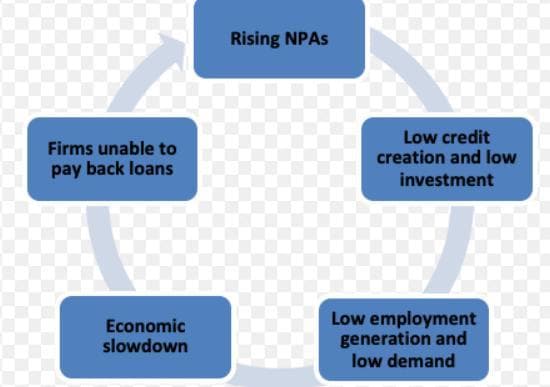
Non-Performing Assets (NPAs) loans unpaid for more than 90 days reflect the financial health of banks. India’s NPA crisis, peaking at 11.6% in 2018 (RBI data), has threatened growth and credit stability. Though recent reforms have improved the situation, structural challenges persist.
Major Causes of NPA Accumulation
a) Corporate Default and Crony Capitalism:
- Excessive lending during the 2008–12 boom to infrastructure and steel sectors led to loan defaults.
- Twin Balance Sheet Problem (RBI, 2017): stressed corporates and burdened banks.
b) Policy and Project Delays:
- Land acquisition hurdles, environmental clearances, and stalled projects inflated costs.
- Example: Power and road projects worth ₹3 lakh crore delayed by 2016 (CAG).
c) Economic Slowdown:
Post-2016 demonetization and COVID-19 disrupted cash flows in MSMEs and services, leading to repayment defaults.
d) Poor Risk Assessment:
- Overestimation of borrower capacity and inadequate due diligence.
- Public sector banks, managing 70% of credit, were particularly affected.
e) Wilful Defaults and Governance Issues:
- High-profile cases like Vijay Mallya (Kingfisher) and Nirav Modi (PNB) highlighted systemic lapses.
Government and RBI Initiatives
- Insolvency and Bankruptcy Code (IBC, 2016): Fast-track resolution within 330 days; recovered ₹3.2 lakh crore (2023).
- Asset Reconstruction Companies (ARCs): Manage bad loans through securitization.
- PSB Recapitalization Scheme (2017–21): ₹3.1 lakh crore infused.
- National Asset Reconstruction Company Ltd. (NARCL, 2021): Centralized bad bank for NPAs above ₹500 crore.
- Prompt Corrective Action (PCA) Framework: Improved oversight.
Example:
Regional banks like Haryana Gramin Bank and State Cooperative Bank implemented One-Time Settlement (OTS) schemes for small borrowers, reducing NPAs from 9.8% (2018) to 4.3% (2023).
India’s NPA crisis was rooted in lax credit culture and regulatory complacency, but recent reforms have strengthened financial discipline. Sustaining this progress will require better credit appraisal, corporate governance, and transparency.
Haryana’s cooperative banks show that even local reforms can contribute to restoring trust and stability in the broader banking ecosystem.