"--- gives evidence of a planned settlement and mud-brick structure in early Harappan period I. The range of pottery types was similar to that of Kalibangan. Artefacts included uninscribed seals, pottery with graffiti, terracotta wheels, cars, rattles, and bull figurines, chert blades, weights, a bone point, and a muller. A lot of animal bones were found during the excavations, indicating the importance of animal husbandry. A stacked set of hopscotches was found in an open area behind the structural complex. This suggests the possibility that a game similar to pithu, which is popular among children in India and Pakistan, goes back to early Harappan times!" - this statement is a description of which Harappan site in India?
Options
ABanawali, Haryana
BAlamgirpur, UP
CDholavira, Gujarat
DRakhigarhi, Haryana
Show AnswerHide Answer
Correct Answer
DRakhigarhi, Haryana
Model Answer
Rakhigarhi, Haryana
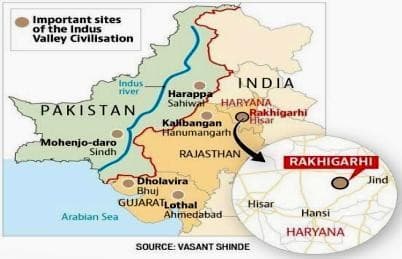
The site of Rakhigarh is one of the five known biggest townships of Harappan civilization on Indian sub-continent, situated in the Hisar district of Haryana, approximately 150 kilometers northwest of Delhi. Other four are Harappa, Mohenjodaro and Ganveriwala in Pakistan and Dholavira (Gujrat) in India.
The archaeological excavations revealed mature Harappan phase represented by planned township having mud-brick as well as burnt-brick houses with proper drainage system.
The ceramic industry represented by red ware, which included dish-on-stand, vase, jar, bowl, beaker, perforated jar, goblet and handis.
Numerous artifacts have been found, including pottery, beads, tools, terracotta figurines, and seals.
Animal sacrificial pit lined with mud brick and triangular and circular fire altars on the mud floor have also been excavated that signifiest the ritual system of Harappans.
Other antiquities included blades; terracotta and shell bangles; beads of semiprecious stones, terracotta, shell and copper objects; animal figurines, toy cart frame and wheel of terracotta; bone points; inscribed steatite seals and sealings.
The excavations at Rakhigarhi have unearthed a variety of animal bones, including those of domesticated animals such as cattle, buffalo, sheep, goat, and pig.indicates that these animals were likely domesticated and played a crucial role in the agrarian economy of the Harappans.
The Indus Valley Civilization is known to have had various forms of games, including dice and board games. In some Harappan sites, markings that resemble game boards or grids have been found.
Map of important Indus Valley Civilisation sites in Pakistan and India, with Rakhigarhi in Haryana enlarged in an inset.