'Regur' word means 'cotton' and is derived from the Telugu word 'Reguda'.
Black soil is also popularly known as Black cotton soil because cotton is the major crop grown on this soil.
According to pedologists, the solidification of lava spread over large areas during volcanic activity in the Deccan Plateau, thousands of years ago led to the origin of Black soil.
The soil is found in Gujarat, Maharashtra, Karnataka, and Madhya Pradesh on the Deccan lava plateau and the Malwa Plateau.
Following are the features of black soil
It is mature soil with a high water-retaining capacity.
It swells and becomes sticky when wet and shrinks after drying.
It has a clayey texture and is self-plowing soil.
It is rich in iron, lime, calcium, potassium, aluminum, and magnesium; while deficient in nitrogen, phosphorous and organic matter.
Additional Information
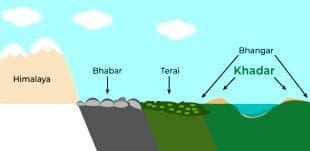
Khadar soil
It is the new alluvial soil composed of fine silt and clay.
It is fertile soil and found on much of the Indo-Gangetic floodplain.
Bhabar soil
This soil is found across the northernmost stretch of the Indo-Gangetic plain along the Shiwalik foothills.
It is also a form of alluvial soil and its most unique feature is its porosity. The porosity is the result of the deposition of a huge number of pebbles and rock debris across the alluvial fans.
Bhangar soil
It is the old alluvial soil, full of lime nodules and is higher in sandy loam content.
It is a less fertile soil as it is above the flood level and carries patches of alkaline efflorescence.
A cross-section sketch from the Himalaya showing the Bhabar, Terai, Khadar and Bhangar belts.