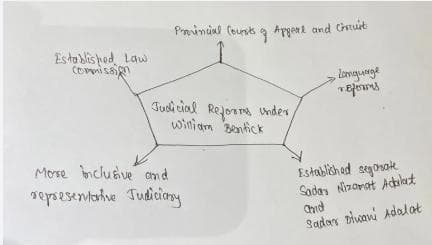
Q1(b). Write about the Judicial Reforms in British India.
Marks: 4Word limit: 125
Show AnswerHide Answer
Model Answer
“British rule transformed India’s judicial structure more than any other administrative sphere.” Judith Brown
Judicial reforms in British India were undertaken to impose uniformity, codify laws, and strengthen colonial control. Over time, these reforms laid foundations for India’s modern judicial system.
Major Judicial Reforms
Regulating Act, 1773: Established the Supreme Court at Calcutta, the first modern court of record.
Cornwallis Reforms (1787–93): Separated executive and judicial functions, created district and provincial courts, introduced civil service ethics, and curbed corruption. Considered the earliest move toward rule of law.
Indian High Courts Act, 1861: Created High Courts at Calcutta, Bombay, and Madras, merging Supreme Courts and Sadar Adalats.
Codification of Laws (1830–1880):
Macaulay’s contribution led to major codes:
IPC (1860)
CrPC (1861)
Evidence Act (1872)
These ensured uniform legal procedures.
Indian Councils Act (1909) and 1935 Act: Expanded legislative power and partially Indianised the judiciary.
Introduction of Jury Trials, Small Cause Courts, and Village Courts increased accessibility.
Example:
The British established district courts in Ambala, Hisar, and Gurugram. Many colonial court buildings still function as heritage courts today.
British reforms were shaped by colonial interests but created the structural and legal backbone of India’s present judiciary.
Hand-drawn diagram of the judicial reforms under William Bentinck: law commission, provincial courts of appeal and circuit, language reforms, Sadar Adalats and a more inclusive judiciaryDiagram of the positive aspects of the judicial reforms: rule of law, codification of laws, inclusion of European subjects and government servants' accountability