Question
Q11. Why did Akbar introduce the Mansabdari System? Discuss it with the change it brought about in Mughal administration.
Show AnswerHide Answer
Model Answer
“Akbar turned the Mughal Empire from conquest to governance.” - Sir Jadunath Sarkar
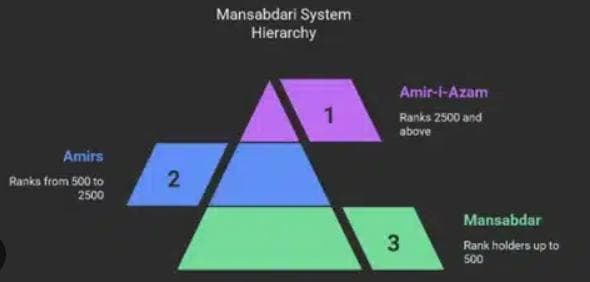
The Mansabdari System, introduced by Emperor Akbar around 1570 CE, was a revolutionary administrative innovation combining military, revenue, and civil functions. It transformed the Mughal state into a merit-based bureaucratic empire.
Purpose and Objectives
- Administrative Centralization: To create a uniform ranking system for military and civil officers, ensuring loyalty and efficiency.
- Integration of Nobility: Unified the Mughal, Rajput, and Afghan nobles under one hierarchy, fostering political stability.
- Revenue and Military Reform: Linked land revenue assessment to service obligations, aligning the interests of officials with the state.
Structure of the Mansabdari System
- Every officer was assigned a Mansab (rank) denoted by two numbers:
- Zat: personal rank, determining salary and status.
- Sawar: number of cavalrymen maintained.
- Mansabdars were paid either in cash or through Jagirs (land grants).
Changes and Impact on Administration
- Professional Bureaucracy: Replaced feudal loyalty with state-based service, ensuring merit-based promotions.
- Revenue Rationalization: Linked land assignments with imperial needs; implemented under Todar Mal’s Bandobast system.
- Military Efficiency: Created a standing, loyal army accountable to the emperor rather than regional chieftains.
- Political Integration: Rajput nobles like Man Singh became senior Mansabdars, strengthening imperial unity.
Long-Term Effects
- Became the backbone of Mughal administration until Aurangzeb’s era.
- However, over-granting of Jagirs later led to financial strain and corruption.
Example:
Historical sites in Hisar and Panipat hosted Mughal garrisons and Jagir estates under this system, linking local governance with imperial authority.
Akbar’s Mansabdari System symbolized the shift from a feudal empire to an organized state apparatus.
By harmonizing revenue, military, and political administration, Akbar laid the foundation of a centralized, efficient, and inclusive governance model that remained unmatched for centuries.