ADemand for labour declines compared to its supply for demographic reasons.
BDemand for labour reduces because of a seasonal swing.
CMore labour is engaged in an occupation than optimally required.
DJobs get reduced because of a negative business cycle.
Show AnswerHide Answer
Correct Answer
CMore labour is engaged in an occupation than optimally required.
Model Answer
Unemployment
A condition where a person eligible to work and looking for it is not able to find work.
An individual on the basis of his activity status can be categorized into the following: Employed, Unemployed, and Neither working nor looking for work.
The first two categories constitute the total labour force.
The unemployment rate can be calculated using the below formula: Unemployment rate = (Unemployed workers/Total labour force) x 100
Following are the types of unemployment
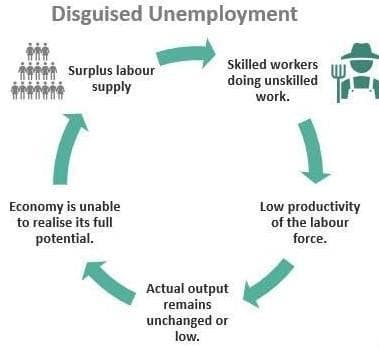
Disguised Unemployment - More labour is engaged in an occupation than optimally required and is usually seen in the agriculture sector.
Seasonal Unemployment - It occurs when a worker is unable to find work during a particular season and this also is seen in the agriculture sector.
Structural Unemployment - It occurs when workers do not have skills according to the jobs available in the market. -
Cyclical Unemployment - It occurs during the recessions in the business cycle.
Technological Unemployment - It occurs due to changes/advancements in technology.
Frictional/Search Unemployment - It occurs when there a time lag between the jobs when an individual is searching for a new job or is switching between the jobs.
Vulnerable Unemployment - It occurs when workers do not have proper job contracts and legal protection. Since their work record is not maintained, they are considered unemployed.
Cycle diagram titled Disguised Unemployment: surplus labour supply, skilled workers doing unskilled work, low productivity, unchanged or low output, economy unable to realise its full potential.