Consider the following statements regarding the Foreign Portfolio Investment (FPT) in India:
1. It has fluctuated drastically in the past decade.
2. In 2022-23, the net FPI in India was less than 1% of the GDP.
3. Foreign Exchange Management Act, 1999 is the primary legislation governing FPI in India.
How many of the statements given above are correct?
Options
AOnly 1
BOnly 2
CAll Three
DNone
Show AnswerHide Answer
Correct Answer
CAll Three
Model Answer
Foreign portfolio investment (FPI) consists of securities and other financial assets passively held by foreign investors. It does not provide the investor with direct ownership of financial assets and is relatively liquid depending on the volatility of the market.
Examples of FPIs include stocks, bonds, mutual funds, exchange traded funds, American Depositary Receipts (ADRs), and Global Depositary Receipts (GDRs).
FPI is part of a country’s capital account and is shown on its Balance of Payments (BOP).
FPI is often referred to as “hot money” because of its tendency to flee at the first signs of trouble in an economy. FPI is more liquid, volatile and therefore riskier than FDI.
Foreign portfolio investments (FPIs) into India have witnessed a significant reshuffling in the pecking order among regions. Hence, statement 1 is correct.
The surge is linked to strengthened India-Europe ties, resulting in three financial agreements.
The net FPI flows into India during the period 2022-23 were impacted by various global factors, such as rising interest rates in the United States, high inflation, and geopolitical concerns like the Russia-Ukraine conflict.
As a result, the overall contribution of FPI to India's GDP remained minimal, contributing less than 1% during FY 2022-23, reflecting the cautious stance of global investors toward emerging markets like India amid uncertain global conditions. Hence, statement 2 is correct.
FEMA was enacted to facilitate external trade and payments and to promote the orderly development and maintenance of the foreign exchange market in India. It regulates all cross-border transactions involving foreign exchange, including FPI.
Under FEMA, specific regulations related to Foreign Portfolio Investment have been framed. The Reserve Bank of India (RBI) and the Securities and Exchange Board of India (SEBI) are the key regulatory bodies that oversee FPI under FEMA. Hence, statement 3 is correct.
Additional information
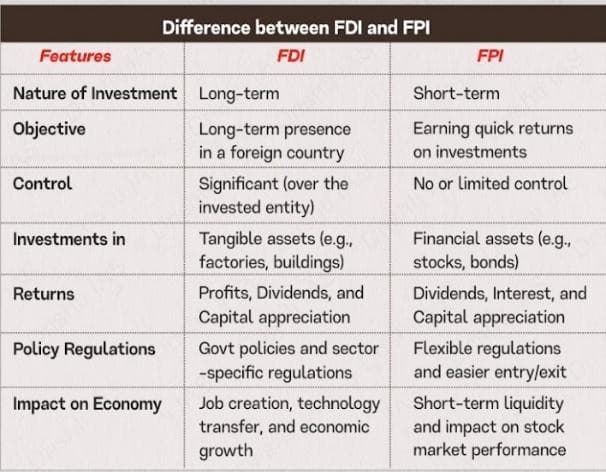
A table headed Difference between FDI and FPI comparing nature of investment, objective, control, investments in, returns, policy regulations and impact on economy.