Question
Do you think India will meet 50 per cent of its energy needs from renewable energy by 2030? Justify your answer.
Show AnswerHide Answer
Model Answer
“India has pledged not only to meet its climate targets but to exceed them.” Prime Minister Narendra Modi, COP26 Glasgow
India, the world’s third-largest energy consumer, is undergoing a historic transition toward cleaner energy. At COP26, India committed to fulfilling 50% of its cumulative electric power capacity from non-fossil fuel sources by 2030 and achieving Net Zero by 2070. With ambitious policies, massive solar expansion, and global partnerships, India is moving steadily but challenges in storage, financing, and grid modernization remain.
Current Status of Renewable Energy in India
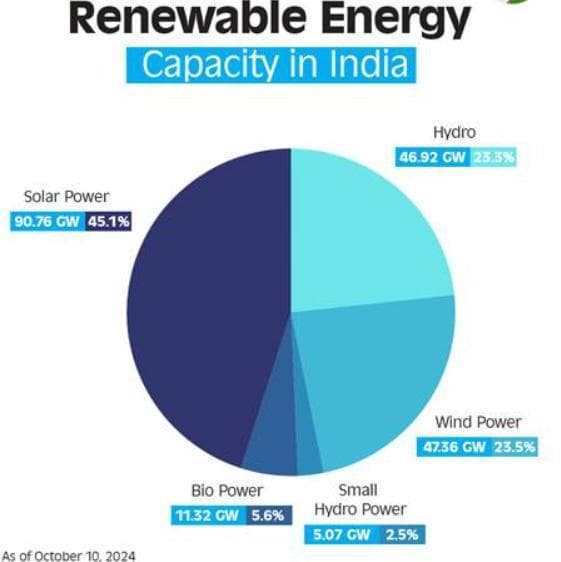
As of Oct 2024, India’s installed renewable energy capacity (excluding large hydro) reached 195 GW, including:
- Solar: 90 GW
- Wind: 47 GW
- Bio-power: 11 GW
- Large Hydro: 47 GW
Non-fossil fuel capacity now forms ~43% of total installed power capacity (CEA, 2024).
To meet the 2030 target (500 GW), India needs to add about 30 GW annually a pace feasible given current growth trends.
Key Policy and Government Initiatives
- National Solar Mission (NSM): Target of 280 GW solar capacity by 2030.
- Green Energy Corridor Project: Strengthening intra-state and inter-state transmission for renewables.
- PM-KUSUM Scheme: Encourages decentralized solar power and solar pumps for farmers.
- National Hydrogen Mission (2021): Targeting 5 million tonnes of green hydrogen by 2030.
- Battery Energy Storage Mission (2023): For grid balancing and renewable reliability.
- Faster Adoption and Manufacturing of Hybrid and Electric Vehicles (FAME-II): Promotes EV integration with renewable power.
Haryana’s Example: State-Level Renewable Push
- Haryana Solar Power Policy (2021): Aims to achieve 6,000 MW solar capacity by 2030.
- Gurugram and Hisar host large rooftop and industrial solar installations Gurugram alone contributes over 350 MW of rooftop solar power (Haryana Renewable Energy Development Agency, 2024).
- Canal-top solar projects in Karnal and Panipat save land and reduce water evaporation.
- Biomass projects in Kaithal and Jind use paddy straw for energy, supporting stubble management and clean air.
- Haryana also incentivizes solar pumps under PM-KUSUM, benefitting over 35,000 farmers as of 2024.
Positive Indicators Supporting 2030 Target
- Falling Renewable Costs: Solar tariffs dropped from ₹4.63/unit (2016) to ₹2.4/unit (2023).
- Private Sector Investment: Over $10 billion in FY 2023–24 (IEA report).
- Global Partnerships: India co-leads the International Solar Alliance (ISA) and Global Biofuel Alliance enhancing technology and finance access.
- Green Bonds and CSR Funding: Expanding financing for clean projects through SEBI-regulated Green Bonds.
Challenges Hindering Target Achievement
- Intermittency and Storage Issues: Lack of large-scale battery storage affects grid stability.
- Land and Evacuation Constraints: Solar and wind projects face delays due to land acquisition and connectivity.
- Financial Stress in DISCOMs: Weak distribution networks deter private investments.
- Slow Wind Sector Growth: Only 1.5 GW/year capacity addition against required 4–5 GW/year.
- Fossil Fuel Dependence: Coal still contributes ~70% of power generation, especially for base-load demand.
India’s renewable revolution is real and accelerating from Rajasthan’s solar parks to Haryana’s rooftop grids and Tamil Nadu’s wind farms.
While challenges persist, India’s trajectory toward 2030 is optimistic due to strong political will, technological innovation, and global cooperation.
In essence, India may well power half its electricity from renewables by 2030, marking a decisive step toward a sustainable and self-reliant energy future.