Why is radiocarbon dating not good for material more than 30,000 years old?
Options
ABecause all animals emitted radiocarbon before that time
BBecause radiocarbon was not present anywhere before that time
CBecause the amount of C14 becomes almost immeasurable small in 30,000 years
DBecause carbon extraction was not known before 30,000 years
Show AnswerHide Answer
Correct Answer
CBecause the amount of C14 becomes almost immeasurable small in 30,000 years
Model Answer
Radiocarbon Dating
Radiocarbon dating (also referred to as carbon dating or carbon-14 dating) is a method for determining the age of an object containing organic material by using the properties of radiocarbon, a radioactive isotope of carbon.
The method was developed in the late 1940s at the University of Chicago by Willard Libby, who received the Nobel Prize in Chemistry for his work in 1960.
It is based on the fact that radiocarbon (14 C) is constantly being created in the atmosphere by the interaction of cosmic rays with atmospheric nitrogen.
Carbon 14 is thought to be mainly a product of the bombardment of the atmosphere by cosmic rays, so cosmic ray intensification would affect the amount of carbon 14 in the environment at any given time.
Carbon dating is unreliable for objects older than about 30,000 years, but uranium-thorium dating may be possible for objects up to half a million years old, Dr Zindler said.
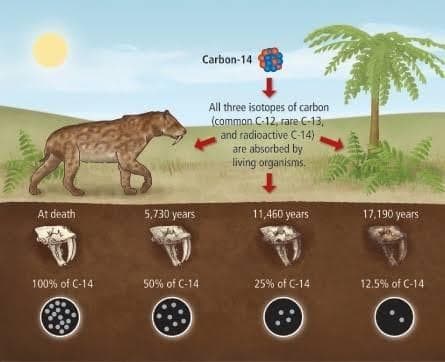
Because carbon-14 has a half-life of 5,730 years. That means half the atoms in a sample will change into other atoms through radioactive decay in that amount of time. That that in turn means it can only accurately measure the age of things that were alive within about the last 60,000 years. Any older and there’s not enough carbon-14 left to measure.
Hence Option C is correct.
Illustration of an animal and a tree absorbing carbon-14, with its share falling from 100% at death to 50%, 25% and 12.5% after 5,730, 11,460 and 17,190 years.