Question
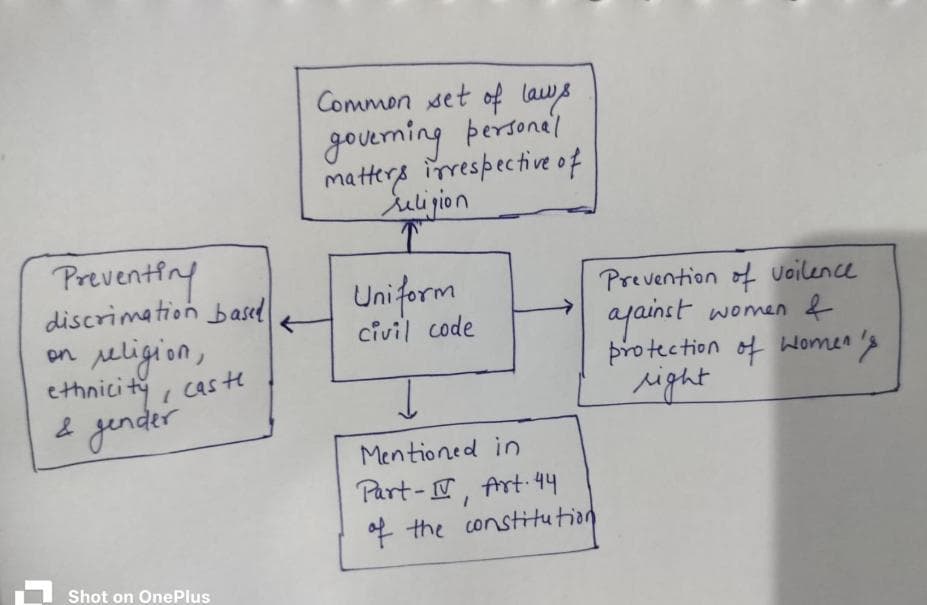
Q1. A Uniform Civil Code in India is a necessity for empowering women. Discuss.
Show AnswerHide Answer
Model Answer
In Shah Bano Case (1985), the Supreme Court observed that “A Uniform Civil Code will help promote national integration by removing contradictions based on ideologies.” The Court emphasized that personal laws should not be a barrier to women’s dignity and rights. Even today, despite constitutional guarantees of equality (Article 14 & 15), women’s rights in marriage, inheritance, divorce and adoption vary across religions, often placing them in unequal positions. Hence, the debate on Uniform Civil Code (UCC) is often framed as a question of gender justice rather than uniformity.
How Personal Laws Currently Disadvantage Women
- Marriage & Divorce: Certain personal laws restrict women’s right to divorce or maintenance, reinforcing dependence.
- Inheritance: In many traditions, sons receive preferential ownership, and widows/daughters get limited rights, despite the Hindu Succession (Amendment) Act, 2005.
- Adoption & Guardianship: Adoption rights are not equally available to women across religious communities.
These unequal legal frameworks reflect and reinforce patriarchal norms.
Why UCC is Considered Necessary for Women’s Empowerment
- Ensures Equal Rights in Property & Inheritance: UCC can mandate equal succession rights irrespective of religion.
- Strengthens Legal Protection Against Abuse: Standardized divorce, maintenance and domestic violence laws protect women better.
- Promotes Economic Independence: Equal rights in marital assets can reduce women's dependency.
- Encourages Social and Legal Identity: Moves from “community-based rights” to “citizen-based rights”, aligning with Article 44 of DPSP.
Thus, UCC can shift women from subjects of customs to holders of constitutional rights.
Recent Developments and Public Discourse
- Law Commission (2023) sought public views on UCC again, noting its relevance for women’s equality and modern family structures.
- States like Uttarakhand (2024) have passed a form of UCC, setting a federal precedent.
This indicates policy momentum and societal readiness for gradual reform.
Special Focus on Haryana
Haryana represents both the challenge and the opportunity regarding gender equality:
| Indicator | Data/ Status | Implication |
|---|---|---|
| Sex Ratio at Birth (2025 SRS) | ~913 females per 1000 males | Patriarchal norms still influence family decisions |
| Female Labour Force Participation (PLFS 2023) | ~23% (below national average) | Economic empowerment remains limited |
| Beti Bachao Beti Padhao launched from Haryana (Panipat, 2015) | Led to measurable awareness gains | Shows success of state-driven gender reforms |
| Khap Panchayat influence in rural areas | Still strong | Customary practices override women’s autonomy |
While Haryana has made notable improvements in gender awareness and educational access, custom-based family decisions still constrain women’s rights, especially in property division and marriage choices.
A Uniform Civil Code could:
- Reinforce equal inheritance and marital property division.
- Limit extra-legal influence of customary councils in matters of women’s mobility and marriage.
- Strengthen state-level gender schemes like Mahila Suraksha Kavach & Self-Help Group microfinance networks.
Thus, UCC could complement Haryana’s gender reforms and push them from policy-level to household-level change.
The debate on UCC must be understood not as cultural homogenization, but as a constitutional movement for women’s equality. India’s demographic and economic aspirations under Viksit Bharat 2047 demand gender-equal legal foundations.
As Justice Chandrachud noted (2017):
“True equality is impossible until women control their own legal and social identity.”