Question
How does watershed management contribute to economic development and social well-being in India?
Show AnswerHide Answer
Model Answer
Watershed management refers to the scientific conservation, utilization, and rejuvenation of land and water resources within a defined drainage area to ensure sustainable livelihoods. In a country like India, where over 60% of agriculture is rainfed, watershed management serves as a cornerstone for rural development, poverty alleviation, and ecological sustainability.
Watershed Management: Meaning and Approach
A watershed is a geographical unit draining rainfall to a common outlet.
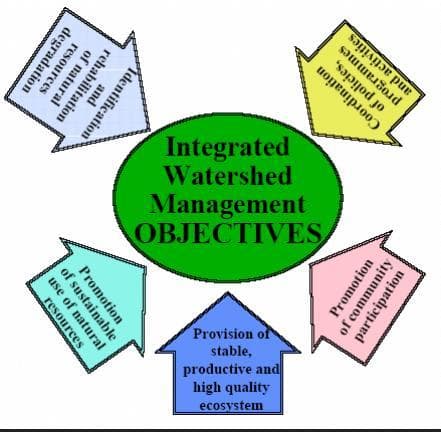
Watershed management integrates soil and water conservation, afforestation, livestock management, and community participation to enhance productivity and resilience.
It adopts a “ridge-to-valley” approach, ensuring soil moisture conservation, groundwater recharge, and sustainable land use.
Contribution to Economic Development
Agricultural Productivity and Income Enhancement
- Improved soil moisture and groundwater recharge lead to increased cropping intensity and yield.
- Example: Under Integrated Watershed Management Programme (IWMP), crop productivity rose by 30–50% in many semi-arid regions (MoRD Report, 2021).
- Farmers shift from subsistence to commercial crops like vegetables, pulses, and fruits.
Livelihood Diversification
- Watershed projects promote animal husbandry, fisheries, horticulture, and agroforestry.
- Mahatma Gandhi National Rural Employment Guarantee Act (MGNREGA) dovetails watershed works with rural employment, generating over 100 crore person-days annually.
Rural Infrastructure and Market Linkages
- Construction of check dams, farm ponds, and field channels improves irrigation and connectivity.
- Local infrastructure attracts agro-industries and reduces distress migration.
4. Boost to Local Economies
NITI Aayog (2022) found that watershed-treated villages witnessed a 22% rise in household income and reduced expenditure on irrigation inputs.
Contribution to Social Well-Being
1. Community Empowerment
- Participatory approach through Watershed Committees and Self-Help Groups (SHGs) strengthens local governance and women’s involvement.
- Women SHGs in watershed projects often lead micro-enterprises like dairy and vermicomposting.
2. Water Security and Health
Revival of local water bodies ensures drinking water availability and reduces water-borne diseases.
3. Ecological Balance
- Reduced soil erosion, increased vegetation cover, and biodiversity restoration enhance long-term sustainability.
- Example: Forest cover improved by 10–15% in treated areas of Madhya Pradesh and Rajasthan.
Case Study: Sukhomajri Watershed, Haryana
- Location: Panchkula district, Haryana
- Background: Initiated in late 1970s by Central Soil and Water Conservation Research and Training Institute (CSWCRTI).
- Key Interventions: Construction of small earthen dams, contour bunding, and participatory management.
Impact:
- Groundwater table rose by 3–4 metres.
- Crop yield of wheat increased from 16 to 50 quintals/ha.
- Milk production tripled, and fodder availability improved.
- Migration declined, and community-managed water-sharing rules were established.
- Significance: A replicable model for participatory watershed management adopted in Haryana, Gujarat, and Karnataka.
Government Initiatives
- Integrated Watershed Management Programme (IWMP) merged into Pradhan Mantri Krishi Sinchayee Yojana (PMKSY), 2015.
- National Watershed Development Project for Rainfed Areas (NWDPRA).
- Jal Shakti Abhiyan (2020) focuses on rainwater harvesting and water reuse.
- Atal Bhujal Yojana (2019) promotes community-led groundwater management in states like Haryana and Gujarat.
Watershed management acts as a catalyst for rural transformation, linking ecological restoration with economic empowerment. It enhances productivity, reduces vulnerability, and fosters inclusive growth embodying the essence of “Gram Swarajya through Jal Swarajya.”
As climate change intensifies, scaling up participatory watershed models like Sukhomajri can ensure that India’s growth remains rooted in sustainability, resilience, and community well-being.