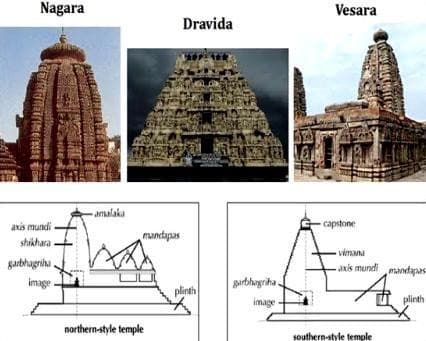
Which were the three main traditional styles of temple architecture in India?
Options
ANagara, Kalasha and Mandapa
BVesara, Dravida and Ratha
CNagara, Vesara and Dravida
DNagara, Vimana and Shikara
Show AnswerHide Answer
Correct Answer
CNagara, Vesara and Dravida
Model Answer
Two broad orders of temples in the country are known
Nagara styles of temple architecture in North India.
Dravida styles of temple architecture in South India.
The Vesara style of temples as an independent style created through the selective mixing of the Nagara and Dravida orders is mentioned by some scholars.
Hence Nagara, Vesara and Dravida is the correct answer.
Additional Information
The basic form of the Hindu temple comprises the following:
A cave-like sanctum (Garbhagriha literally ‘womb house), which, in the early temples, was a small cubicle with a single entrance and grew into a larger chamber in time.
The Garbhagriha is made to house the main icon which is itself the focus of much ritual attention.
The entrance to the temple may be a portico or colonnaded hall that incorporates space for a large number of worshippers and is known as a Mandapa.
From the fifth century CE onwards, freestanding temples tend to have a mountainlike spire, which can take the shape of a curving Shikhar in North India, and a pyramidal tower, called a vimana, in South India.
At the top of the temple, Kalasha or Sikhara has been placed.
The Vahan, i.e., the mount or vehicle of the temple’s main deity along with a standard pillar or Ahvaz is placed axially before the sanctum.
Photographs of Nagara, Dravida and Vesara temples with line diagrams of a northern-style and a southern-style temple plan.