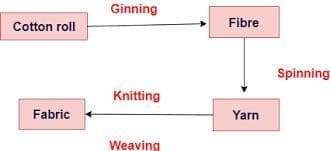
Consider the following pairs
1. Ginning | Separation of cotton fibres from seeds
2. Weaving | Making yarn from fibres
3. Polyester | Melts on catching fire and sticks to the body
How many of the above pairs are correctly matched?
Options
AOnly one pair
BOnly two pairs
CAll three pairs
DNone of the pairs
Show AnswerHide Answer
Correct Answer
BOnly two pairs
Model Answer
Ginning
Ginning is the process of separating cotton fibres from their seeds. Hence, statement 1 is correct.
This process is essential in the production of cotton textiles, as it prepares raw cotton for spinning into yarn.
Ginning is the first step in the cotton textile production chain.
Efficient ginning improves the quality of the cotton lint, which in turn enhances the quality of the final textile product.
Spinning
Spinning is the process of converting fibres into yarn. Hence, statement 2 is incorrect.
This is a key step in textile manufacturing, as yarn is then used to weave or knit fabrics.
Weaving
Weaving is the process of interlacing two distinct sets of yarns or threads—warp (vertical) and weft (horizontal)—to form a fabric or cloth.
This process is fundamental to textile production.
Polyester
Polyester is a synthetic polymer made from petroleum-based products, and it is widely used in textiles due to its durability and resistance to shrinking and stretching.
However, polyester is highly flammable and can catch fire easily. Hence, statement 3 is correct.
Polyester's flammability can lead to significant hazards in fire incidents, especially in places like factories, homes, or during large gatherings
Flow diagram of cotton textile making: cotton roll to fibre by ginning, fibre to yarn by spinning, yarn to fabric by weaving, with knitting also labelled.