Question
“India’s membership of QUAD has qualitatively altered the security scenario in indo-Pacific.” Comment.
Show AnswerHide Answer
Model Answer
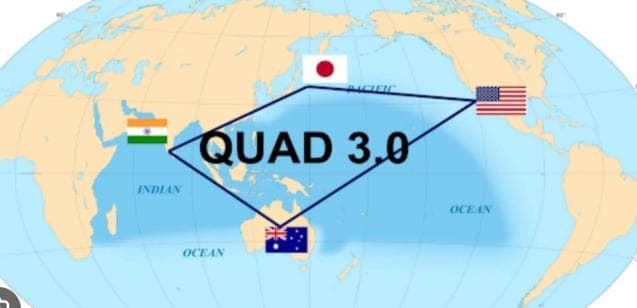
The Quadrilateral Security Dialogue (QUAD) comprising India, the United States, Japan, and Australia has emerged as one of the most significant strategic groupings in the Indo-Pacific region. Originally conceived in 2007 and revived in 2017, QUAD represents a shared vision for a “free, open, inclusive, and rules-based Indo-Pacific.”
India’s active membership in QUAD has not only elevated its strategic profile but also reshaped the regional security architecture, influencing both maritime stability and great-power dynamics.
India’s Role in QUAD: A Transformative Shift
India’s participation marks a shift from continental security focus to maritime strategic engagement. It reflects India’s growing recognition that the security of the Indian Ocean and Pacific Ocean are interlinked a perspective in line with its Act East Policy and Indo-Pacific Vision.
How India’s QUAD Membership Has Altered the Indo-Pacific Security Scenario
1. Maritime Security and Freedom of Navigation
QUAD focuses on ensuring freedom of navigation, maritime domain awareness, and adherence to the UNCLOS (United Nations Convention on the Law of the Sea).
India’s navy, with its geostrategic location and blue-water capabilities, plays a central role in securing sea lanes of communication (SLOCs) vital for global trade particularly the Malacca Strait and the Andaman–Nicobar Command.
Example: Exercise MALABAR (2023), hosted by Australia, included advanced anti-submarine and air-defense drills, enhancing interoperability among QUAD navies.
2. Balancing China’s Assertiveness
QUAD serves as a strategic counterweight to China’s aggressive posture in the South China Sea, Indian Ocean, and along India’s northern borders.
India’s participation has deterred unilateral dominance, aligning regional security with democratic norms and sovereignty.
After the Galwan Valley clash (2020), India deepened defense ties within QUAD reflecting how continental and maritime strategies are now interlinked.
3. Disaster Relief, Cybersecurity, and Non-Traditional Security
QUAD is not a military alliance but a multi-dimensional security platform addressing emerging challenges.
The QUAD Humanitarian Assistance and Disaster Relief (HADR) Mechanism (2022) enhances coordination during natural disasters and pandemics.
Collaboration on cybersecurity and supply-chain resilience ensures protection from digital threats and economic coercion.
4. Vaccine and Health Security Diplomacy
During the COVID-19 pandemic, the QUAD Vaccine Partnership (2021) committed to supplying over 1 billion vaccine doses to Indo-Pacific nations.
India’s pharmaceutical capacity and Vaccine Maitri initiative made it the production hub, showcasing its role as a security and health provider in the region.
5. Infrastructure and Connectivity Initiatives
QUAD launched the Indo-Pacific Partnership for Maritime Domain Awareness (IPMDA, 2022) to counter illegal fishing and monitor maritime activities using satellite data.
India collaborates with Japan and Australia under the Supply Chain Resilience Initiative (SCRI) to reduce dependence on China-centric manufacturing.
QUAD’s focus on clean energy, 5G security, and critical minerals aligns with India’s Atmanirbhar Bharat and Digital India missions.
6. Strategic Autonomy and Multi-Alignment
India’s participation reinforces its strategic autonomy it engages QUAD while maintaining ties with Russia (BRICS) and China (SCO).
Quantitative and Institutional Impact
- Trade: QUAD members collectively account for 35% of global GDP and over 40% of Indo-Pacific trade.
- Military Exercises: India has participated in over 60 Indo-Pacific naval interactions (2021–24) through QUAD frameworks.
- Infrastructure Investments: QUAD announced $50 billion in regional connectivity projects (2023–27) focusing on ports, green technology, and resilient logistics chains.
- Blue Economy Cooperation: India’s SAGAR (Security and Growth for All in the Region) complements QUAD’s maritime vision, integrating smaller island nations.
Challenges and Limitations
- Diverging national priorities (e.g., US focus on China containment vs. India’s preference for cooperative engagement).
- Lack of institutionalized structure like NATO.
- China’s perception of QUAD as a “containment alliance” risks regional polarization.
- Limited defense industrial cooperation so far.
India’s membership of QUAD has qualitatively transformed the Indo-Pacific’s security landscape from fragmented regional cooperation to a cohesive democratic partnership.
However, to sustain this momentum, India must pursue balanced engagement, stronger economic linkages, and proactive diplomacy ensuring the Indo-Pacific remains free, open, inclusive, and multipolar.
As Prime Minister Narendra Modi aptly stated at the Tokyo QUAD Summit (2022):
“The QUAD has become a force for global good where democracy, trust, and transparency sail together.”