Which of the following statements about the parasite is/are true?
1. Dodder is a plant parasite, which has special sucking roots called haustoria for absorption of food from the host plant.
2. Dodder is a vine-like parasitic plant and is essentially leafless
3. Many species of Dodder cause weed problems in the horticulture industry.
4. Once the Dodder plants get attached itself to the host plant it loses its root system.
Choose the correct answer from the Options given below:
Options
A2 and 4 only
B3 and 4 only
C1,3 and 4 only
D1,2,3 and 4
Show AnswerHide Answer
Correct Answer
D1,2,3 and 4
Model Answer
About Dodder
It is a parasitic plant that has special roots called haustoria for absorbing nutrients from the host plant. Hence, Statement 1 is correct.
It lacks chlorophyll and cannot perform photosynthesis. It's a holoparasitic plant, which means it gets all of its nutrition from another plant through haustorial (sucking) roots.
Dodder has many host plants, including agricultural crops, weeds, ornamentals, and other plants.
Dodder is also known as Cuscuta.
Dodder is a vine-like parasitic plant and is essentially leafless. Hence, Statement 2 is correct.
Many species of Dodder cause weed problems in the horticulture industry. Hence, Statement 3 is correct.
Once the Dodder plant gets attached itself to the host plant it loses its root system. Hence, Statement 4 is correct.
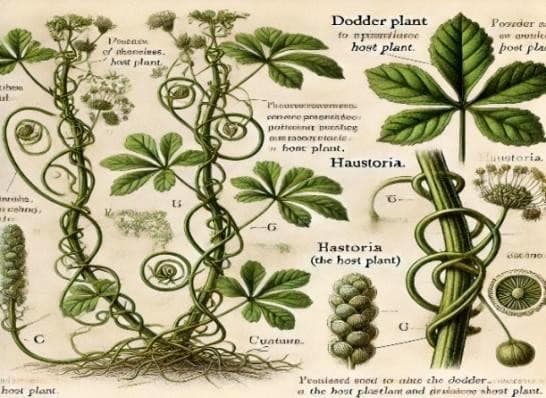
A botanical-style illustration of a dodder plant twining round a host plant, with haustoria labelled.