Question
What is the basic principle behind vaccine development? How do vaccines work?
Show AnswerHide Answer
Model Answer
“The discovery of vaccines is one of humanity’s greatest victories turning disease prevention into a triumph of science over suffering.” -WHO, Global Immunization Report (2023)
Vaccines represent one of the most powerful tools in modern medicine, saving 3–5 million lives annually (WHO, 2023). The basic principle behind vaccine development lies in training the immune system to recognize and combat pathogens viruses or bacteria without causing the disease itself. The goal is to build immunological memory, ensuring a faster and stronger immune response upon real infection.
Basic Principle Behind Vaccine Development
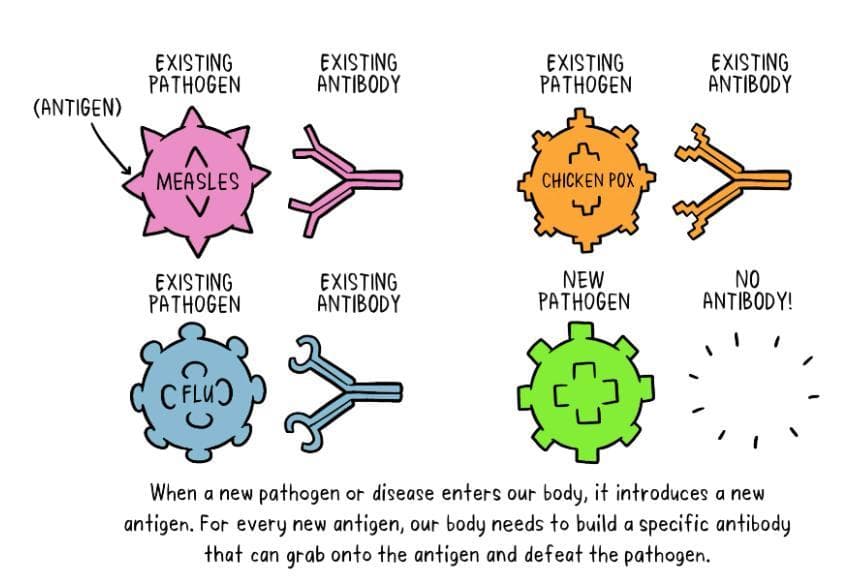
The core principle of vaccine development is based on the concept of adaptive immunity the body’s ability to “remember” past infections. Vaccines use antigens derived from the pathogen (either whole, weakened, killed, or a part of it) to stimulate the body’s immune response safely.
Key Principles:
- Mimic Natural Infection: Introduce an antigen similar to the pathogen to elicit an immune response.
- No Disease, Only Immunity: The antigen is modified so it cannot cause illness but still provokes immune defense.
- Memory Formation: Immune cells (T and B lymphocytes) remember the pathogen, providing long-term protection.
- Herd Immunity: When a large proportion of the population is vaccinated, transmission rates fall, indirectly protecting unvaccinated individuals.
Major Types of Vaccines
| Type | Principle | Example |
|---|---|---|
| Live Attenuated | Uses a weakened pathogen that can replicate without causing disease. | Measles, Mumps, Rubella (MMR) vaccine |
| Inactivated/Killed | Uses dead pathogens to trigger immune response. | Polio (IPV), Rabies vaccine |
| Subunit/Protein-based | Contains purified pathogen fragments (antigens). | Hepatitis B, HPV vaccine |
| Toxoid | Ues inactivated bacterial toxins to induce immunity. | Tetanus, Diphtheria |
| mRNA/DNA-based | Delivers genetic code (mRNA/DNA) to produce viral proteins in the body. | Pfizer-BioNTech and Moderna COVID-19 vaccines |
| Viral Vector-based | Uses a harmless virus to deliver the gene for the target antigen. | Covishield (Oxford–AstraZeneca) |
How Do Vaccines Work? (Mechanism of Action)
Antigen Introduction:
The vaccine introduces antigens molecules resembling the pathogen into the body.
Immune Activation:
- Macrophages and dendritic cells capture and present these antigens to T cells.
- Helper T cells activate B cells, which produce specific antibodies.
Formation of Memory Cells:
Memory T and B cells remain in the body for years or decades, providing long-term protection.
Secondary Response:
If exposed to the real pathogen later, the immune system mounts an immediate and strong defense, preventing disease.
Indian Context: Vaccine Development and Innovation
- India is known as the “Pharmacy of the World”, producing over 60% of global vaccines (UNICEF, 2023).
- Bharat Biotech’s Covaxin India’s indigenous inactivated COVID-19 vaccine.
- Serum Institute of India’s Covishield largest producer of the Oxford–AstraZeneca vaccine.
- Mission Indradhanush (2014) expanded immunization coverage to 95% of children by 2023.
- Haryana Example: Panipat and Gurugram host cold-chain facilities for vaccine logistics under Universal Immunization Programme (UIP) ensuring rural coverage and safe storage.
Importance of Vaccines
- Prevent infectious diseases like polio, smallpox, and measles.
- Reduce infant and child mortality (India’s under-5 mortality rate fell from 126 in 1990 to 32 in 2023, UNICEF).
- Strengthen public health infrastructure and global disease surveillance.
- Enable economic stability by preventing pandemic-induced disruptions.
Challenges Ahead
- Vaccine hesitancy due to misinformation.
- Cold-chain logistics in rural areas.
- Emerging mutations that may evade existing vaccines.
- Equitable distribution, both within and across nations.
The science of vaccination rests on a simple yet profound principle stimulate the immune system today to protect life tomorrow.
India’s success with vaccines like Covaxin and Covishield, combined with programs like Mission Indradhanush, showcases how innovation and public policy can work together to achieve health security.
Vaccines thus represent not only biological shields but also symbols of scientific solidarity ensuring that humanity remains one step ahead of disease.