Question
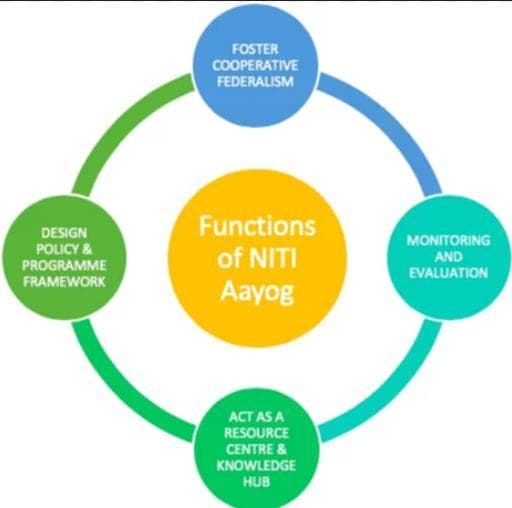
List the major functions of the NITI Aayog and discuss the major alterations it has brought in the planning process of India.
Show AnswerHide Answer
Model Answer
“NITI Aayog represents not just a change in name, but a change in the very soul of India’s planning from centralized control to cooperative and competitive federalism.”
-Prime Minister Narendra Modi (2015)
The NITI Aayog was established on 1st January 2015, replacing the Planning Commission (1950–2014).
It reflects India’s transition from a command-and-control economy to a market-driven and cooperative federal framework.
Major Functions of NITI Aayog
Policy Formulation and Strategic Planning
- Acts as a “think tank” providing long-term policy direction to the government.
- Formulates strategic documents like:
- “Strategy for New India @75” (2018) sets 75 national milestones across 41 sectors.
- Vision@2047 envisions India as a developed economy by 2047 through sustainability and inclusion.
Example: The Aspirational Districts Programme (ADP, 2018)conceptualized by NITI Aayog uses data-driven governance to uplift backward districts.
Promoting Cooperative and Competitive Federalism
- Encourages collaboration between the Centre and States through the Governing Council chaired by the Prime Minister.
- Facilitates ranking-based performance competition among states.
Example: State Health Index, SDG India Index, and School Education Quality Index (SEQI) promote healthy competition.
Haryana ranked among top five states in the NITI SDG Index 2023 for its strong performance in clean energy and gender equality.
Fostering Innovation and Entrepreneurship
Atal Innovation Mission (AIM) promotes innovation through Atal Tinkering Labs (ATL) and Atal Incubation Centres.
Haryana Example: 300+ schools host ATLs; Govt. Model Senior Secondary School, Hisar won the AIM innovation award (2023) for developing a solar irrigation prototype.
Monitoring and Evaluation of Government Schemes
NITI Aayog conducts Outcome-Based Monitoring (OBM) replacing the old input-centric evaluation of the Planning Commission. Example: Evaluation of PM Awas Yojana (Urban) and Jal Jeevan Mission guided mid-course corrections in implementation.
Development Monitoring and Evaluation Office (DMEO) ensures data transparency and accountability.
Sustainable Development and Climate Action
NITI Aayog coordinates India’s efforts toward achieving the UN Sustainable Development Goals (SDGs). SDG India Index monitors progress across 17 goals.
Haryana’s Initiatives:
Haryana's rank in the NITI Aayog's SDG India Index for 2023-24 was 13th, with a score of 72
Public–Private Partnerships (PPP) and Investment Facilitation
Haryana collaborated with NITI for Value Chain Development in Agro-Industries (2023), connecting farmers in Karnal to food processing clusters under PM Kisan Sampada Yojana.
Policy Research, Capacity Building, and International Collaboration
Partners with global organizations such as UNDP, World Bank, and OECD for policy innovation. NITI–UNDP SDG Coordination Centre (Haryana, 2018) established in Chandigarh to assist Haryana in integrating SDG goals with state policies.
Impact of NITI Aayog on Planning Transformation
1. Decentralized and Data-Driven Governance
States now design their own State Development Plans aligned with NITI’s goals.
Haryana Vision 2030, prepared with NITI’s support, integrates SDGs into district-level planning.
2. Encouraging Policy Experimentation
States are given flexibility to innovate; NITI identifies best practices for replication.
Haryana’s Saksham Yuva Programme, which links unemployed youth to skill training and self-employment, was showcased in NITI’s Best Practices Compendium (2022).
3. Strengthened Centre–State Coordination
Regular meetings of the Governing Council ensure shared ownership of national reforms like Digital India, PM Gati Shakti, and National Logistics Policy (2022).
Haryana’s logistic hubs in Gurugram and Palwal are being developed in sync with the PM Gati Shakti Master Plan, reflecting integrated planning.
4. Long-Term National Vision
The shift from annual plans to long-term strategic planning enhances policy continuity and adaptability.
NITI’s Vision@2047 aligns industrial policy, digital economy, and green growth targets under a single framework.
NITI Aayog has transformed India’s planning paradigm from rigid resource allocation to dynamic, cooperative, and innovation-based governance.
By empowering states like Haryana through data-driven evaluation, performance-based incentives, and SDG localization, it has bridged the gap between policy intent and policy impact.
Thus, NITI Aayog symbolizes India’s evolution from planned economy to performing economy, where policy reforms are participatory, measurable, and future-ready.