The movement of the earth on its own axis is termed rotation.
The earth rotates along its axis (imaginary line) from west to east, this is the reason the sun rises in the east and sets in the west.
The days and nights occurring on the earth are the results of the earth's rotation.
The Circle of Illumination divides the day from night on the globe.
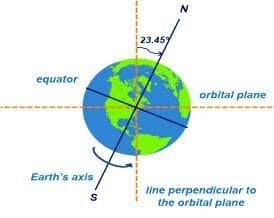
Earth's axis is tilted and the axis makes an angle of 23.5° with the normal and an angle of 66.5° with the orbital plane (the plane of earth’s orbit around the sun).
Time is taken by the earth in one rotation - 23 hours 56 minutes and 40.91 seconds.
Rotational velocity at the equator - 1667 km/hr.
Rotational velocity at the poles - zero.
The French physicist Leon Foucault is known for measuring the speed of the earth’s rotation.
The rotation of the earth has an effect on the following - the direction of the wind, cyclones, ocean currents, and change of day and night.
A diagram of the earth's tilted axis, 23.45 degrees from the line perpendicular to the orbital plane, with the equator and orbital plane marked.