Given below are two statements:
Statement - I: Chandrayaan-2 was launched on July 22, 2019, from Sriharikota by a Geosynchronous Satellite Launch Vehicle Mark III. The spacecraft consisted of an orbiter, a lander, and a rover.
Statement - II: The orbiter will circle the Moon in a polar orbit at a height of 100 km (62 miles).
In the light of the above statements, choose the most appropriate answer from the options given below:
Options
ABoth Statement - I and Statement - II are correct
BBoth Statement - I and Statement - II are incorrect
CStatement - I is correct but Statement - II is incorrect
DStatement - I is incorrect but Statement - II is correct
Show AnswerHide Answer
Correct Answer
ABoth Statement - I and Statement - II are correct
Model Answer
Chandrayaan-2
On July 22, 2019, at 09:13:12 UTC, a GSLV Mark III-M1 launched the spacecraft on its mission to the Moon from the second launch pad at the Satish Dhawan Space Centre in Andhra Pradesh.
After Chandrayaan-1, Chandrayaan-2 is the second lunar exploration mission created by the Indian Space Research Organization (ISRO).
It consists of a lunar orbiter as well as an Indian-developed lander and rover on the moon, the Vikram and Pragyan. Hence statement I is correct.
The Orbiter will orbit from 100 km away, while the Lander and Rover modules will separate and make a soft landing on the surface. Hence statement II is correct.
Additional Information
Chandrayaan 3 is India's third lunar mission and second attempt at achieving a soft landing on the moon's surface.
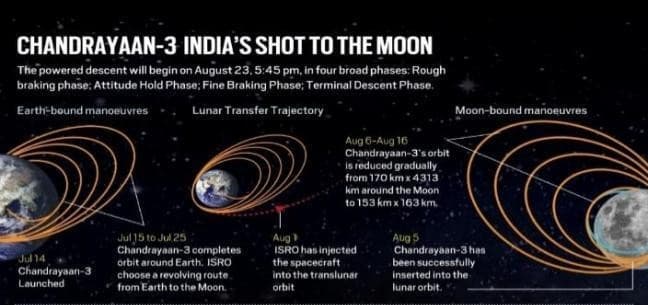
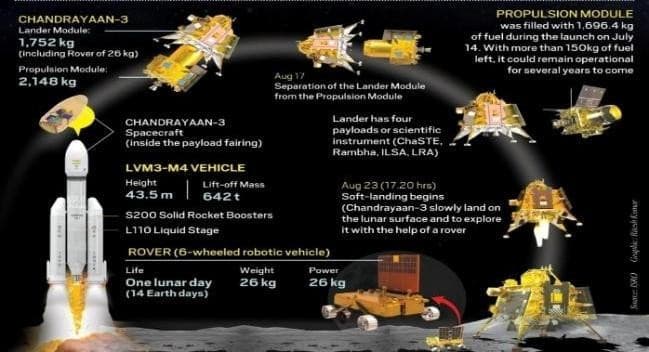
On July 14, 2023, Chandrayaan-3 took off from the Satish Dhawan Space Centre in Sriharikota. The spacecraft seamlessly entered lunar orbit on August 5, 2023. The historic moment unfolded when the lander made a successful touchdown near the Lunar south pole on Aug 23, 2023.
An infographic of Chandrayaan-3's path to the Moon: earth-bound manoeuvres, lunar transfer trajectory and moon-bound manoeuvres, with dates.An infographic of the Chandrayaan-3 spacecraft: the LVM3-M4 launch vehicle, lander, propulsion module, rover and the soft landing on 23 August.