Question
What are the objectives of Chandrayaan–2?
Show AnswerHide Answer
Model Answer
“Exploration is not a choice it’s an imperative for human progress.” - Dr. A.P.J. Abdul Kalam
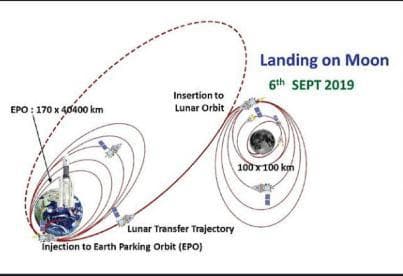
India’s Chandrayaan–2, launched by ISRO on 22 July 2019 using the GSLV–Mk III rocket from Sriharikota, was the second lunar exploration mission after Chandrayaan–1 (2008). It represented a leap in India’s space capabilities, aiming to expand knowledge of the Moon’s surface, mineralogy, and exosphere, while demonstrating complex landing technologies.
Key Objectives
Scientific Exploration of the Moon:
- To map the lunar surface composition, topography, and mineral distribution, especially around the South Polar Region, which remains largely unexplored.
- To study lunar exosphere, water-ice presence, and elemental abundance using payloads like Imaging IR Spectrometer (IIRS) and Dual-Frequency Synthetic Aperture Radar (DFSAR).
Technological Demonstration:
- To achieve a soft landing on the Moon and operate a rover (Pragyan) for in-situ analysis of the lunar surface a milestone attempted by very few nations.
- To validate autonomous navigation, hazard detection, and communication systems between orbiter, lander, and ground station.
Orbital Studies:
The Orbiter, still operational (as of 2024), continues to transmit high-resolution data from 100 km orbit for lunar mapping and supports Chandrayaan–3’s landing navigation.
Strengthening India’s Space Research Ecosystem:
- Enhanced indigenous R&D in deep-space missions, telemetry, and spacecraft autonomy.
- Provided critical data for ISRO’s Chandrayaan–3 (2023) success.
Achievements and Impact
- The Orbiter’s Terrain Mapping Camera–2 provided data confirming water molecule presence near the lunar poles.
- Demonstrated 90–95% mission success rate, despite lander malfunction during descent.
- Boosted India’s global standing in planetary science and lunar cartography.
Example:
Haryana’s Kurukshetra University and NIT Kurukshetra have collaborated with ISRO in optical payload analysis and student research programs under Student Satellite Initiative, fostering local scientific talent.
Chandrayaan–2 exemplified India’s determination to master complex space technologies and expand the frontiers of lunar science. It laid the foundation for future interplanetary missions proving that even setbacks can propel innovation and resilience in India’s space journey.