Select the correct statements regarding cleansing action of soap.
1. Hydrophilic end of soap molecules interact with the oily droplets.
2. The formation of micelles in a soap solution during the cleaning of clothes is called emulsification.
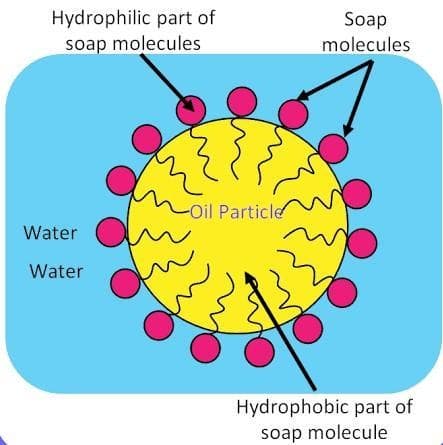
3. The hydrophobic end of the soap molecules is in the inner side during micelle formation.
4. Micelles surround the Ca2+ or Mg2+ ions in hard water instead of oily droplets.
Options
A1, 2 and 3
B1, and 4
C2, and 3
D2, 3 and 4
Show AnswerHide Answer
Correct Answer
D2, 3 and 4
Model Answer
Official answer key: C. The answer shown above (D) is the academy’s own.
Micelle formation
Chemically soap is an example of a sodium/potassium salt of higher fatty acids. It contains both hydrophilic (water loving) and hydrophobic (oil loving) parts. Dirt dissolves in hydrophobic end and forms micelle (a colloidal suspension). Hence, statement 1 is incorrect.
The sodium/potassium ion in soap dissolves in water and the organic fatty acid part dissolves in grease. With grease it forms a colloidal suspension called micelle. The formation of micelle is shown below.
Thus, during this process an emulsion will be formed, and it is called emulsification.
But when soap is used in hard water, its cleaning action decreases. The reason is the cations in hard water react with the hydrophobic end of the soap and form scums and prevent the soap cleaning action.
The formation of micelles in a soap solution during the cleaning of clothes is called emulsification. This process occurs in the cleaning action of soap. The hydrophobic end of the soap molecules is in the inner side during micelle formation. Micelles surround the Ca2+ or Mg2+ ions in hard water instead of oily droplets when soap is treated with hard water. Hence, statement 2, 3 and 4 are correct.
A diagram of a soap micelle: a yellow oil particle in water ringed by soap molecules, with the hydrophilic heads outside and hydrophobic tails inside.