Podu, Beewar, Penda are local names in various parts of India to denote which kind of cultivation?
Options
AIntensive
BExtensive
CShifting
DPlantation
Show AnswerHide Answer
Correct Answer
CShifting
Model Answer
Shifting agriculture
As the name suggests, this is a form of agriculture that shifts from one land to another.
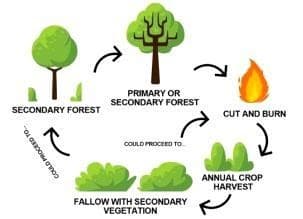
This type of agriculture is done by tribal communities living in the forest areas. A piece of land is cleared to grow crops and then the land is left barren and another land is cleared for growing crops.
Shifting agriculture is advantageous because it gives time for the natural revival of nutrients in the soil. The disadvantage of Shifting agriculture is that it leads to the cutting down of trees, which leads to soil erosion and ecological imbalances.
Podu
It is a Telugu word that denotes a traditional system of cultivation used by tribes in India.
In this type of agriculture, different areas of forest are cleared by burning and the land cleared is used for growing crops.
It is generally practiced in hill-slopes of Andhra Pradesh.
Thus, it is a type of Shifting Agriculture.
Bewar
This type of shifting agriculture is practiced in Madhya Pradesh and Chhatisgarh.
The Baiga tribe in the Mandla and Dindori districts of Madhya Pradesh practice this form of shift cultivation.
It has been outlawed under the Indian Forest Act,1927.
Penda
This is also an illegal form of shift cultivation being practiced in Maharashtra.
It is usually practiced by the Maida tribe in the hilly regions of the Gadchiroli district of Maharashtra.
A cycle diagram of shifting cultivation: secondary forest, primary forest, cut and burn, annual crop harvest, fallow with secondary vegetation.