Question
Q8. Discuss India’s nuclear doctrine and analyse the emerging debates on its ‘no-first-use’ doctrine.
Show AnswerHide Answer
Model Answer
“Nuclear weapons are not weapons of war but instruments of deterrence.” A.P.J. Abdul Kalam
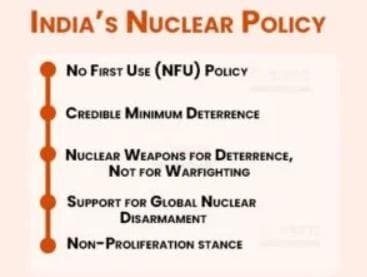
India’s nuclear doctrine, officially outlined in January 2003, reflects its philosophy of credible minimum deterrence and commitment to responsible nuclear behavior. It ensures national security while maintaining global peace through a policy of restraint most notably the ‘No First Use’ (NFU) principle.
Key Features of India’s Nuclear Doctrine
a) No First Use (NFU):
India will not use nuclear weapons first, but will respond massively to any nuclear attack on India or its forces.
b) Credible Minimum Deterrence:
India maintains only the minimum nuclear arsenal required for deterrence, not for power projection.
c) Civilian Control:
The Nuclear Command Authority (NCA), chaired by the Prime Minister, ensures democratic oversight.
d) Non-Use Against Non-Nuclear States:
India pledges not to use nuclear weapons against states without such weapons.
e) Global Disarmament:
India supports total nuclear disarmament through global consensus (as reiterated at UNGA 2023).
Strategic Context of the Doctrine
- Formulated after Pokhran-II nuclear tests (1998) and subsequent regional tensions.
- Balances deterrence against China and Pakistan, both nuclear-armed neighbors.
- Reinforces India’s image as a responsible nuclear power within global non-proliferation norms.
Emerging Debates on the NFU Policy
a) Changing Security Environment:
- Pakistan’s use of tactical nuclear weapons and China’s assertiveness have prompted re-evaluation.
- Defence Minister (2019) hinted that India’s NFU policy “depends on circumstances,” signaling flexibility.
b) Credibility of Deterrence:
Critics argue NFU may limit preemptive response options, especially in the face of imminent threats.
c) Technological Advances:
Development of hypersonic missiles and space-based surveillance alters deterrence dynamics.
d) Support for NFU Continuity:
Strategists like Shivshankar Menon (former NSA) advocate NFU for strategic stability and diplomatic credibility.
Haryana and India’s Strategic Context
India’s Northern Command and missile bases in Haryana and Rajasthan regions highlight the strategic importance of interior states in defense planning. Institutions like DRDO labs and defense education centers in Haryana contribute to India’s deterrent capacity indirectly through R&D and logistics.
India’s nuclear doctrine has successfully balanced deterrence with restraint for over two decades. While debates on NFU are valid amid evolving threats, India’s credibility as a responsible power lies in strategic ambiguity with moral clarity ensuring peace through strength, not provocation.