A couple suspects a mix up of their new born baby in the hospital. Blood typing is sought to resolve the dispute. The man has blood group A and the woman has blood group B. Their biological child can have blood group
1. Either A or B
2. A or B or O or AB
3. A or B or AB
4. Only AB
Choose the correct Option:
Options
A1 only
B2 only
C3 only
D4 only
Show AnswerHide Answer
Correct Answer
A1 only
Model Answer
Blood Group System
The ABO blood group system was discovered in 1900 by Austrian scientist Karl Landsteiner.
He mixed different blood types in his experiments, and he found that the plasma from one blood type produced agglutinates, or clusters, due to the absence of molecules on red blood cells, which led to antibodies that could defeat that molecule.
He then noted the agglutination and divided the blood types into four distinct categories. He won the Nobel Prize for discovering the ABO blood group.
In blood transfusion, the blood grouping system plays a crucial role. If another blood type is introduced into the body, our immune system attacks it, resulting in a transfusion reaction.
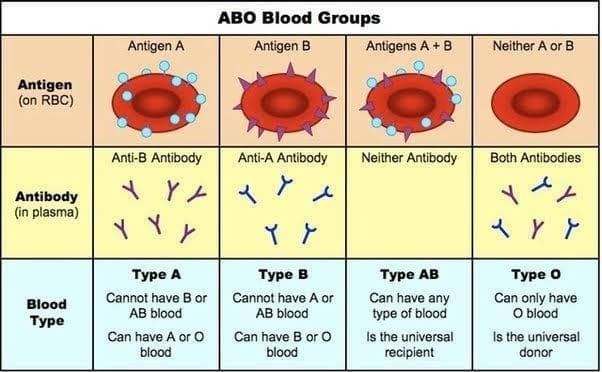
The ABO grouping system is divided into four types based on the presence or absence of antigens on the surface of red blood cells and plasma antibodies.
The two antigens that form the basis of ABO grouping are Antigen A and Antigen B.
Therefore, If both parents are heterozygous (AO and BO), the children could potentially have any of the four blood groups: A, B, AB, or O, with each child having a 25% chance for each blood group under these genetic assumptions.
A chart titled ABO Blood Groups showing, for types A, B, AB and O, the antigens on red cells, the plasma antibodies and which blood each type can have.